Major Arcana · 0
The Fool
Upright new beginnings · trust · curiosity · spontaneity · a leap of faith
Reversed recklessness · hesitation at the threshold · naivety · scattered energy
- Arcana
- Major
- Number
- 0
- Element
- 🜁 Air
- Astrology
- 🜁 Air (element)
- Hebrew letter
- Aleph א
- Yes or no
- Yes
The Fool upright
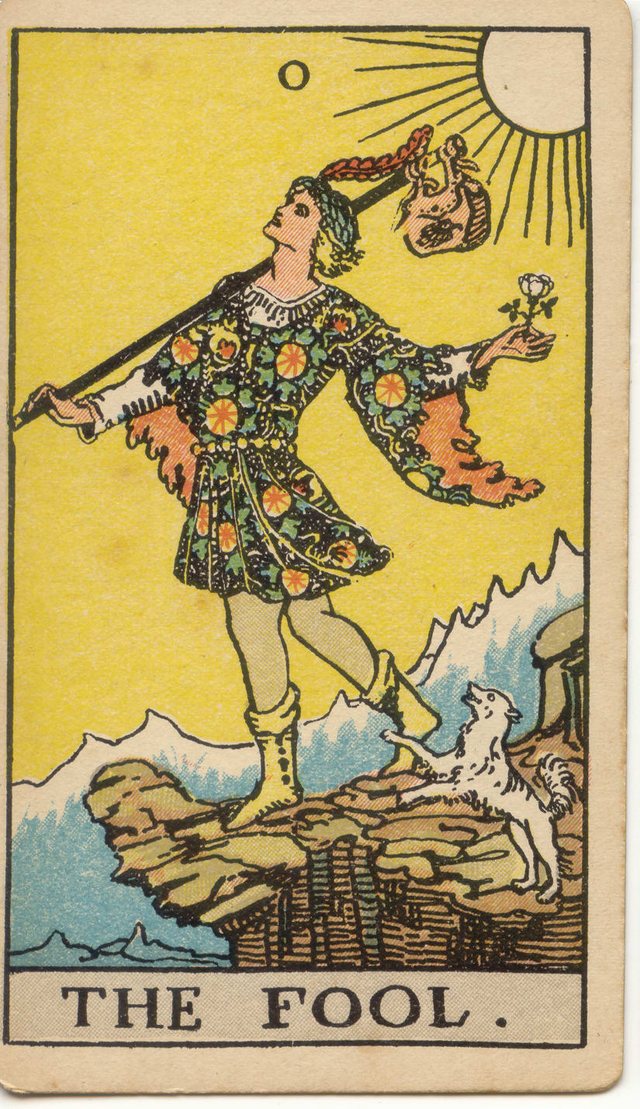
A young man in a flowered tunic steps out along a high rock with his head tipped back, looking at the sky rather than at the drop in front of him. He holds a white rose lightly in one hand, a staff with a small bundle rests on his shoulder, and a white dog jumps up at his side. A pale sun shines in a yellow sky, and white peaks rise in the distance.
The Fool is the card of beginnings that cannot be fully planned. He carries almost nothing and has no map, and the card does not treat that as a failing. It describes the state of mind in which you say yes before you have every answer: a move, a new course, a relationship, a project whose shape you will only learn by starting it. His gift is openness. He has not yet decided what is impossible.
The card is numbered zero, and that matters. Zero is not low; it is potential, the point before counting starts. Many readers see the rest of the Major Arcana as the Fool's travels, each card a person or lesson met on the road. The cliff is real, and the card is honest about risk, but it is also a picture of trust. The dog may be warning him or urging him on. Either way, the next step is his.
The Fool reversed
Upside down, the Fool's openness can tip into carelessness: leaping without checking anything, brushing off advice, mistaking impulse for freedom. It can describe someone who keeps starting things and finishes none, or who treats other people's concerns as dull rather than useful.
The reversal can also point the other way, to a beginning you are refusing to make. Fear of looking foolish keeps you on the ledge long after you know you want to go. Readers who treat reversals as blocked energy often read it like this. The question is whether the risk you are weighing is real or simply unfamiliar.
In love and relationships
In love the Fool is the unplanned connection: the person you meet when you were not looking, or a relationship that feels light and new with no history to weigh it down. For couples it can call for play, doing something together that neither of you has tried before. It does not promise permanence, and it is not especially interested in it. Reversed, it can show someone charming but unready to commit, or a habit of jumping into romance before you know who the other person is.
In work and purpose
At work the Fool fits a first job, a change of career, a freelance leap or the early days of a venture when enthusiasm is ahead of experience. It encourages you to learn by doing and to ask the questions an expert would be embarrassed to ask. It also asks for a little practical sense: the Fool carries a bundle, after all, not nothing. Reversed, it warns against signing up for something on a whim, or against staying in a role you have outgrown because the next step feels too uncertain.
As advice
Take the step, but take it with your eyes open. You do not need a complete plan to begin, only enough honesty to know why you are going and enough lightness to adjust once you are under way. Let curiosity lead for a while, and listen if the dog barks.
Yes or no?
Yes The Fool favours beginning and saying yes to the unknown, though it is a yes that comes without guarantees. How yes-or-no readings work here.
Questions to sit with
- What would I try if I were not afraid of looking inexperienced?
- Am I standing at this edge out of caution, or out of habit?
- What am I carrying that I could set down before I start?
Symbolism in the card
The cliff edge
The young man stands on a jutting rock with nothing but air ahead of him. The edge is the threshold of every real beginning, the place where planning stops and experience starts. Waite insisted that for the Fool it 'has no terror'.
The white dog
A small white dog leaps up beside him, head turned towards his face. It has been read as instinct, as loyalty and as a warning bark. On this card it looks as eager as its master: a companion rather than a guard.
The white rose
He holds a single white rose up in his left hand, barely gripping it. White roses traditionally stand for innocence and purity of motive: desire that has not yet been complicated by experience or by wanting something back.
The staff and bundle
A black staff rests on his right shoulder with a small embroidered bag tied to the end. It is all the luggage he has. Waite said its 'dim signs' held memories stored in the soul; most readers simply notice how little the Fool needs to set out.
The sun and yellow sky
A white sun with long rays shines in the top right corner of a bright yellow sky. Waite describes it as a sun that 'knows whence he came, whither he is going'. The yellow ground of the card gives it daylight, optimism and clear air.
The flowered tunic
His dark tunic is covered in round orange-and-green motifs, like flowers or small wheels, and lined in orange-red at the sleeves. The rich clothes mark him as no beggar: Waite calls him 'a prince of the other world on his travels through this one'.
The red feather
A red feather rises from the green wreath on his head and streams behind him. Feathers suggest lightness and the freedom of air; red is life and appetite. The detail gives a dreamy figure a flash of vitality.
The distant mountains
Icy white peaks fill the background. Mountains often stand for challenges and for the heights of attainment. Here they are far off, a reminder that the road he is starting on is a long one.
“The edge which opens on the depth has no terror; it is as if angels were waiting to uphold him, if it came about that he leaped from the height. His countenance is full of intelligence and expectant dream.”
Numbers, elements and astrology
Number 0: Zero
Zero is the open circle before counting starts: pure potential, nothing yet decided. Only the Fool carries it, which is why the Fool can stand at the beginning or the end of the trumps.
Air
Air is thought, speech, truth and conflict: the mind and its sharp edges.
These are the traditional attributions of the Hermetic Order of the Golden Dawn (1888), which Waite and Smith followed: each trump is matched to a Hebrew letter and to an element, planet or zodiac sign. They are a symbolic system, not astronomy. How we checked them.
A little history
The Fool is among the oldest tarot images, though it began as an outsider. Early Italian cards show a ragged, half-dressed figure, sometimes with feathers in his hair, and the card carried no number; in many card games it served as an excuse rather than a trump. The Tarot de Marseille calls him Le Mat, a vagabond with a bundle on a stick while an animal tugs at his leggings. The Golden Dawn placed him at the head of the trumps as zero. Smith turned the beggar into a well-dressed youth at a cliff's edge, with a white rose, a white dog and the sun behind him.