Major Arcana · XII
The Hanged Man
Upright surrender · pause · a new perspective · letting go · waiting with purpose
Reversed stalling · needless sacrifice · resistance · indecision
- Arcana
- Major
- Number
- XII
- Element
- 🜄 Water
- Astrology
- 🜄 Water (element)
- Hebrew letter
- Mem מ
- Yes or no
- Maybe
The Hanged Man upright
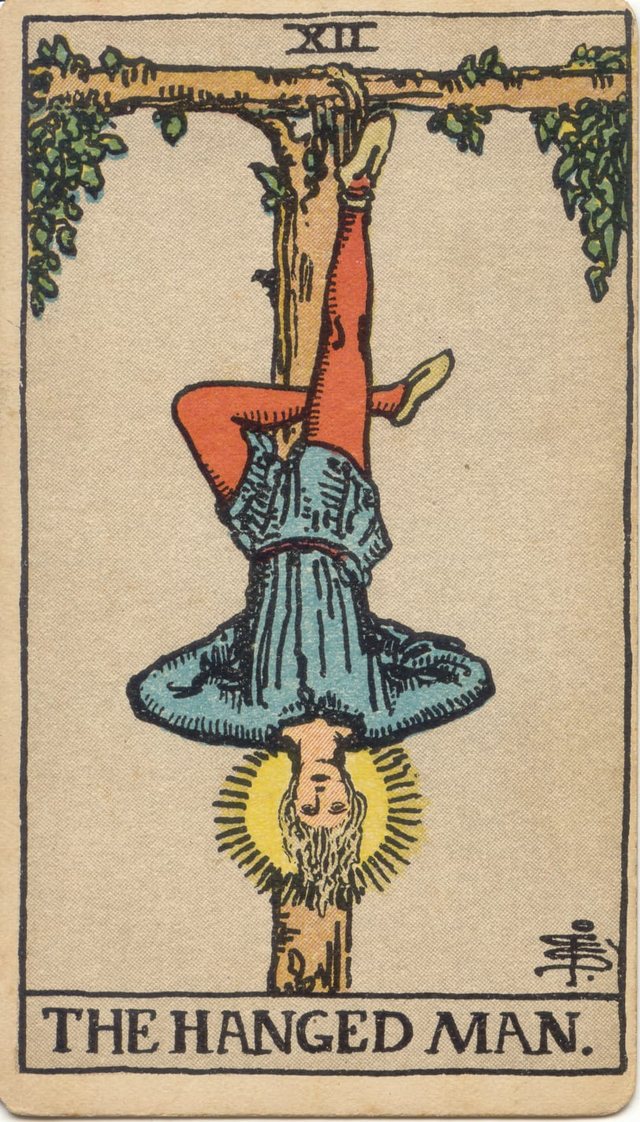
A young man hangs upside down from a T-shaped beam of living wood, tied by one ankle. His other leg bends behind the straight one to make a rough figure four, his arms are folded out of sight behind his back, and a yellow halo glows around his head. He wears a blue tunic and red hose. Strangest of all is his face: calm, almost absent, with no sign of pain.
That calm is the key to the card. The Hanged Man describes a time when pushing harder will not help and the only real move is to stop. You may be waiting on something outside your control, or you may need to let go of a fixed idea about how a situation ought to go. Hanging upside down, he sees the same world everyone else sees, but from an angle nobody else is using. The card often turns up when the answer is not more effort but a change of view.
It can also speak of sacrifice: giving up a smaller thing for a larger one, time for skill, comfort for integrity. The difference between this and martyrdom is that the choice is made freely and with open eyes. The halo suggests that something becomes clear precisely because he has stopped struggling.
The Hanged Man reversed
Reversed, the figure is the right way up again, and readers interpret that in two opposite ways. Some see the pause ending: the suspension lifts and things begin to move. More often the reversal points to the unhelpful side of waiting: stalling because a decision is uncomfortable, or holding on in a situation that no longer asks anything of you.
It can also describe sacrifice that has curdled into resentment, giving and giving without anyone having asked. If this card comes reversed, ask honestly whether you are waiting for insight or simply avoiding a step you already know you need to take.
In love and relationships
In love the Hanged Man often shows a relationship in a holding pattern: a long-distance stretch, a partner who is not ready, a question that cannot be rushed. It asks you to look at the situation from your partner's side, or from the side you have been avoiding. For someone single, it can suggest a deliberate pause from dating to understand what you actually want. Reversed, notice if you are putting your life on hold for someone who has not asked you to.
In work and purpose
At work the card fits projects on hold, a hiring freeze, a sabbatical, or the frustrating weeks before a decision is made above your head. Rather than fighting the delay, it suggests using it: learning, rethinking the brief, testing an assumption everyone takes for granted. Many breakthroughs come from someone who looked at a problem upside down. Reversed, it can warn of a role in which you keep giving more than is reasonable without recognition or reward.
As advice
Stop pushing for a moment. Turn the problem over and ask how it would look to someone with the opposite view. Let go of the outcome you have been insisting on, and see what becomes visible once you are no longer straining against it.
Yes or no?
Maybe The Hanged Man is a card of suspension, so the honest answer is not yet: wait, and look again. How yes-or-no readings work here.
Questions to sit with
- What am I trying to force that might resolve if I stopped?
- How would this situation look if I turned my assumptions upside down?
- Is the sacrifice I am making one I have chosen, or one I have drifted into?
Symbolism in the card
The living T-shaped beam
The gallows is a tau-shaped tree: a trunk with a crossbar, both sprouting green leaves. Waite pointed out that it is living wood. The man is not hanging from a dead instrument of punishment but from something still growing, which turns the scene from execution towards renewal.
The halo
A circle of yellow light radiates round the man's head, which hangs near the bottom of the card. Halos mark holiness or illumination. Here it suggests that his insight comes in the inverted state, not in spite of it.
The crossed legs
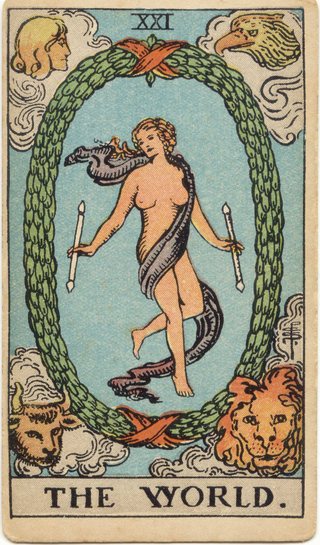
One leg is straight, tied at the ankle, while the other bends behind it at the knee. The shape is often compared to a figure four or a cross. Waite called it a fylfot cross; many readers link it to the World, where the dancer's legs cross in a similar way.
The hidden hands
His arms are folded behind his back and out of sight. With his hands unavailable he cannot act, grasp or defend himself: the card's lesson that some situations ask for receptivity rather than doing.
The calm face
Upside down at the bottom of the picture, the face is serene with heavy-lidded eyes. Waite stressed that it expresses 'deep entrancement, not suffering'. Whatever this ordeal is, the man has accepted it.
The blue tunic and red hose
A belted blue tunic falls towards his head, with red hose on his legs and pale yellow shoes. Readers often take the red as passion and physical life and the blue as calm and thought, both held still in one body.
The plain background
There is no landscape, sky or ground, just a flat pale field. Unusually for Smith's Majors, nothing distracts from the figure. The emptiness fits a card about suspension, where the ordinary world has fallen away for a while.
“It should be noted (1) that the tree of sacrifice is living wood, with leaves thereon; (2) that the face expresses deep entrancement, not suffering; (3) that the figure, as a whole, suggests life in suspension, but life and not death.”
Numbers, elements and astrology
Number 12, reduced to 3 (1 + 2): Three
Three is the first number that makes a shape: two things meet and produce a third. It is the number of growth, collaboration and first results.
Water
Water is feeling, intuition, relationships and the imagination.
These are the traditional attributions of the Hermetic Order of the Golden Dawn (1888), which Waite and Smith followed: each trump is matched to a Hebrew letter and to an element, planet or zodiac sign. They are a symbolic system, not astronomy. How we checked them.
A little history
In fifteenth-century Italy this card was often called il Traditore, the Traitor, and is usually linked to the custom of shaming traitors in public paintings that showed them hanging by one foot. The Visconti-Sforza and Marseille versions show a young man suspended from a gallows; on the Marseille card it is a beam between two trimmed trees, and the title is Le Pendu. Later occultists reinterpreted him as an image of prudence or sacrifice. Smith's version replaced the gallows with a living tau-shaped tree and added the halo, which together turn a picture of disgrace into one of willing surrender.