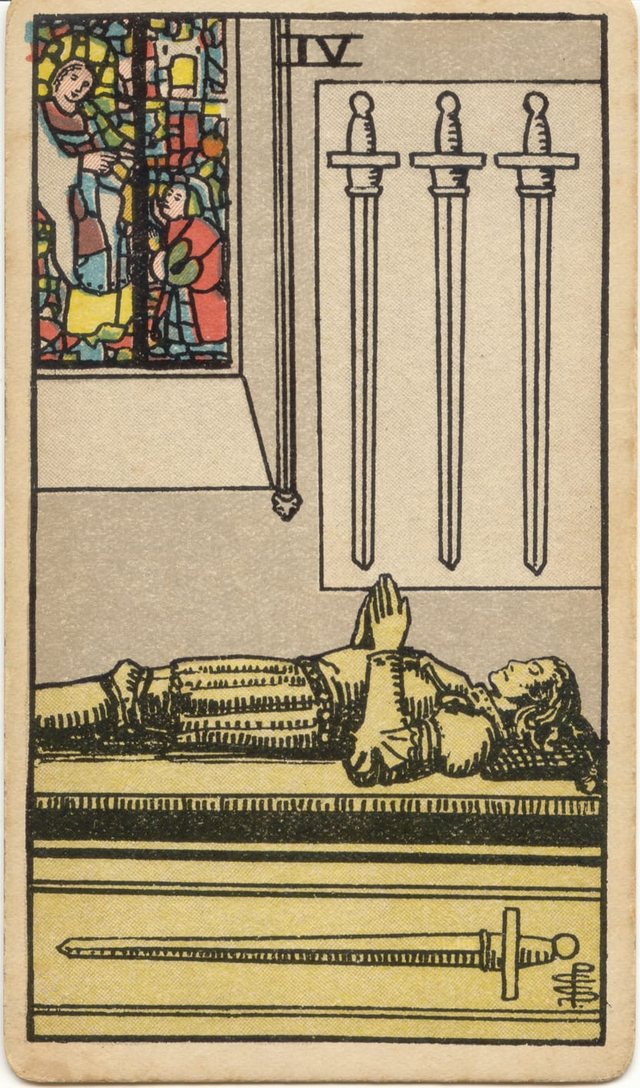
Four of Swords
Upright rest · recovery · retreat · contemplation · a necessary pause
Reversed restlessness · burnout · returning too soon · forced stillness
- Arcana
- Minor · pip card
- Number
- Four
- Element
- 🜁 Air
- Astrology
- ♃ Jupiter in ♎ Libra
- Golden Dawn title
- Lord of Rest from Strife
- Yes or no
- Maybe
Four of Swords upright
Inside a church, a knight lies at full length on top of a tomb, his hands pressed together in prayer and his eyes closed. He is carved, not living: the effigy on his own monument, in pale yellow armour. Three swords hang point-down on the wall above him and a fourth is cut into the side of the tomb. In the upper left corner a stained-glass window shows two figures in red, blue and gold, one standing over the other, which may be read as a blessing or a petition. The room is quiet, grey and still.
After the heartbreak of the Three, the Four is the suit's first real rest. It describes the moment you put the weapons down, not because the conflict is settled but because you cannot think clearly while still fighting. That can mean sleep, a holiday, a retreat, a period of illness or grief in which recovery is the only task, or simply an evening with the phone switched off. Swords are the suit of the mind, and this card is the mind given permission to stop.
The tomb is not a threat. Waite admitted that his old meanings, "tomb and coffin", had suggested the design, but the card is usually read as withdrawal rather than an ending. The knight is still a knight. The swords are within reach. The pause is a preparation, and the card often suggests that resting now is the most productive thing available.
Four of Swords reversed
Turned upside down, the card describes rest that is either missing or misused. You may be pushing on long after you needed to stop, or returning to a fight before you have recovered, and the result is short temper, poor sleep and decisions made tired. Some readers see the reversal as burnout announcing itself, the body insisting on the rest the mind keeps refusing. The card then asks what would have to change for a real pause to be possible.
The opposite reading also exists: a retreat that has gone on too long and become hiding, or stillness imposed from outside rather than chosen. Waite's reversed meanings lean practical, "circumspection, economy", suggesting careful management while you get back on your feet.
In love and relationships
In love, the Four of Swords often describes a breathing space: time apart after an argument, a pause in dating after a painful breakup, or a couple who need rest more than another serious conversation. It does not mean the relationship is over, only that little useful gets decided while everyone is exhausted. For someone single, it can be a good time to be quietly on your own. Reversed, it may show one person ready to talk again while the other still needs space.
In work and purpose
At work the card fits leave, a sabbatical, a quiet week after a major deadline, or the honest admission that a team is too tired to make good calls. It can also describe research and reflection, stepping out of the daily rush to think about strategy. If you are being pressed to decide something now, it suggests asking for time. Reversed, it may point to burnout, to working through an illness, or to a pause that has drifted into avoidance.
As advice
Stop for a while. Put down the arguments, the planning and the replaying of what went wrong, and let your body and mind recover. Rest is not a reward you have to earn. The swords will still be there when you come back, and you will hold them better.
Yes or no?
Maybe The card asks for a pause before deciding, so it reads as not yet rather than a firm yes or no. How yes-or-no readings work here.
Questions to sit with
- What would I need to put down in order to rest properly?
- Am I retreating to recover, or retreating to avoid something?
- What does my mind feel like when it is genuinely quiet?
Symbolism in the card
The knight's effigy
A knight in yellow armour lies on his back on the tomb, eyes closed, hands joined in prayer. Waite called it 'the effigy of a knight'. It is a figure at rest rather than a body: vigilance and devotion held in perfect stillness.
The three swords on the wall
Three plain swords hang point-down on a pale panel above the tomb. They are out of hand but not gone: the conflicts and thoughts of the suit, set aside for now and waiting.
The sword on the tomb
A fourth sword is carved horizontally along the side of the tomb. Lying flat, it is the one blade that has truly been laid down, and the most literal image of a truce with oneself.
The tomb
A long yellow stone chest, its lid ridged with mouldings, supports the effigy. A tomb is the strongest possible image of withdrawal, and the card borrows its quiet rather than its finality.
The stained-glass window
In the upper left a coloured window shows one figure standing over another, smaller one who seems to look up. The exact subject is hard to make out in the scan. It brings colour and a hint of blessing or comfort into the grey room.
The church interior
Grey walls, a column and a hanging cord or rod define an enclosed sacred space. The setting is sheltered and silent, a place set apart from the world where retreat is expected and respected.
“Vigilance, retreat, solitude, hermit's repose, exile, tomb and coffin. It is these last that have suggested the design.”
Numbers, elements and astrology
Four
Four is the square: stability, structure and rest, with the risk of standing still. Fours in tarot often show something held in place.
Air: the suit of Swords
Air is thought, speech, truth and conflict: the mind and its sharp edges.
By Golden Dawn tradition each numbered card from two to ten rules ten degrees of the zodiac (a decan): the Four of Swords is Jupiter in the third decan of Libra. They are a symbolic system, not astronomy. How we checked them.
A little history
The Tarot de Marseille four of swords is a pattern of curved blades, often with a flower at the centre, and no scene. The Golden Dawn titled it the Lord of Rest from Strife, a name that fits Smith's picture closely. Waite says plainly that the old divinatory words "tomb and coffin" suggested the design, which shows how Smith's scenes were often built outward from the meanings Waite gave her rather than from earlier images.