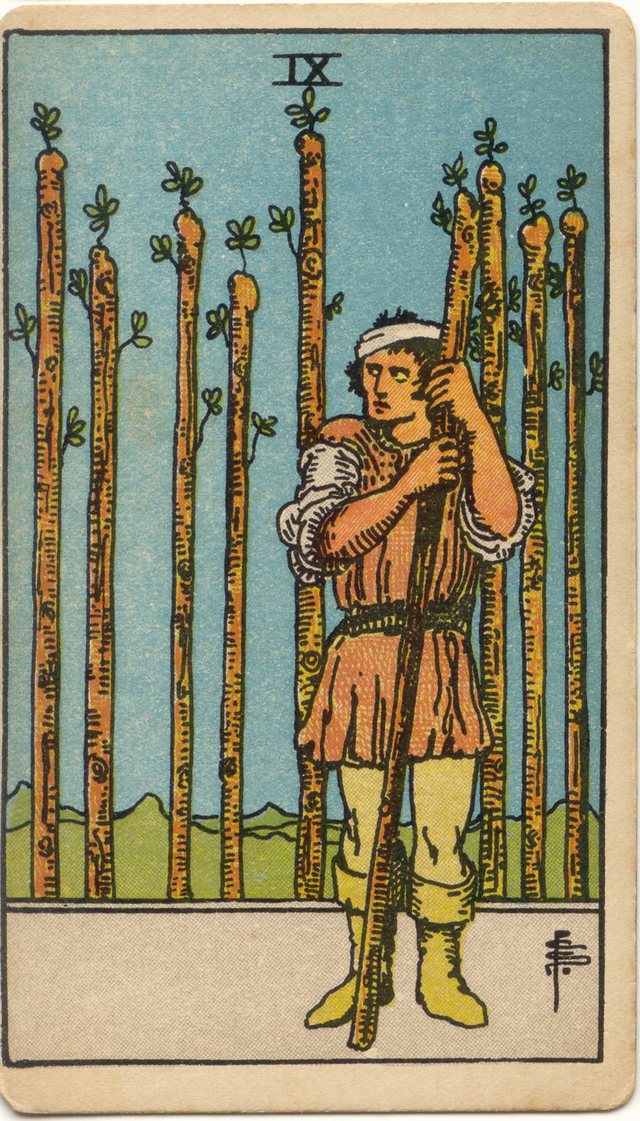
Nine of Wands
Upright resilience · persistence · vigilance · the last stretch · boundaries
Reversed exhaustion · suspicion · giving up · refusing help
- Arcana
- Minor · pip card
- Number
- Nine
- Element
- 🜂 Fire
- Astrology
- ☽ Moon in ♐ Sagittarius
- Golden Dawn title
- Lord of Great Strength
- Yes or no
- Maybe
Nine of Wands upright
A man stands in front of a row of eight upright wands, holding a ninth close against his chest with both hands. A white bandage is wrapped around his head. He looks sideways out of the corner of his eye, wary and watchful. He wears a reddish tunic with full white sleeves and pale yellow boots, and stands on a bare grey strip of ground in front of low green hills.
Waite saw him as expectant, as if awaiting an enemy, with the wands behind him set like a palisade. He has already been hurt: the bandage says so. But he is still upright, still holding his wand, still at his post. The card is about resilience between battles, the stretch when you are tired and guarded but very nearly through. Waite reads it as strength in opposition and adds delay and suspension, a waiting period that simply has to be endured.
There is a shadow side worth naming. Someone who has been hit before tends to expect the next blow, and vigilance can harden into suspicion. The card asks you to tell the difference between a genuine threat and an old wound talking. Often its message is to hold on a little longer; sometimes it asks whether you can lower your guard.
Nine of Wands reversed
In the reversed position, the endurance runs out. You may feel too depleted to keep going, or close to giving up on something that has cost more than you expected. That can be a sign to rest, ask for help, or admit that this particular fight is no longer worth what it costs you.
Other readers see defensiveness gone too far: refusing all help, distrusting everyone, holding the line long after the danger has passed. Waite's reversed meanings are blunt: obstacles, adversity, calamity. Read gently, the reversed Nine asks what you would need in order to feel safe enough to stop standing guard.
In love and relationships
In love the Nine of Wands often describes someone who has been hurt before and is protecting their heart: interested, but watchful. It can also suit a relationship going through a long trial, two people tired but still committed. It asks whether old wounds are making you see threats in a partner who means no harm. Reversed, it may show the guard turned into a wall, or one person simply too drained to keep trying.
In work and purpose
At work the card fits the late stage of a long project or campaign, when energy is low and setbacks have piled up but the end is close. It favours persistence and protecting what you have built, including your own time and limits. It can also describe a defensive workplace culture. Reversed, it may point to burnout, an inability to delegate, or suspicion of colleagues that does more harm than good.
As advice
You are closer to the end than it feels. Hold your position, but tend your wounds while you do: rest where you can, accept help where it is offered. Watch for real threats, and do not spend your strength guarding against ones that have already passed.
Yes or no?
Maybe The Nine of Wands points to a yes only through persistence, so the answer depends on whether you can hold on. How yes-or-no readings work here.
Questions to sit with
- What old wound am I still carrying into new situations?
- How much further do I really have to go?
- Who could I let stand beside me at this line?
Symbolism in the card
The bandaged head
A white bandage is bound around his forehead. He has already fought and been hurt. Smith added this detail, which is not in Waite's description, and it turns the card's resilience into the kind that comes after injury.
The sideways glance
His eyes slide to one side as though listening for someone approaching. It is the look of vigilance, and of a man who no longer takes safety for granted.
The wand held close
He clutches one wand upright against his chest with both hands and leans on it. It is support and weapon at once, the last resource he keeps closest to him.
The palisade of eight wands
Eight leafy wands stand behind him in an even row, Waite's orderly palisade. They are his defences, everything he has built or won, and they also hem him in.
His clothing
A reddish tunic, full white sleeves and pale yellow boots: the plain dress of a watchman rather than a lord. This is endurance at ground level, not command.
“The figure leans upon his staff and has an expectant look, as if awaiting an enemy. Behind are eight other staves—erect, in orderly disposition, like a palisade.”
Numbers, elements and astrology
Nine
Nine stands just short of completion: the fullness of a suit's energy, sometimes as fulfilment and sometimes as its burden.
Fire: the suit of Wands
Fire is will, energy, desire and creativity: the drive that starts things.
By Golden Dawn tradition each numbered card from two to ten rules ten degrees of the zodiac (a decan): the Nine of Wands is Moon in the second decan of Sagittarius. They are a symbolic system, not astronomy. How we checked them.
A little history
In the Golden Dawn system this is the Lord of Great Strength, and Waite's reading, strength in opposition, follows it closely. Earlier decks offered nine batons and nothing more; the watchful guard is Smith's. Her bandage is the detail most readers now remember, yet Waite's own description of the card does not mention it. In his additional meanings he calls the Nine, generally speaking, a bad card, a harsher view than most modern readers take.