Major Arcana · XV
The Devil
Upright attachment · temptation · compulsion · materialism · feeling trapped
Reversed breaking free · reclaiming power · facing a habit · release
- Arcana
- Major
- Number
- XV
- Element
- 🜃 Earth
- Astrology
- ♑ Capricorn
- Hebrew letter
- Ayin ע
- Yes or no
- No
The Devil upright
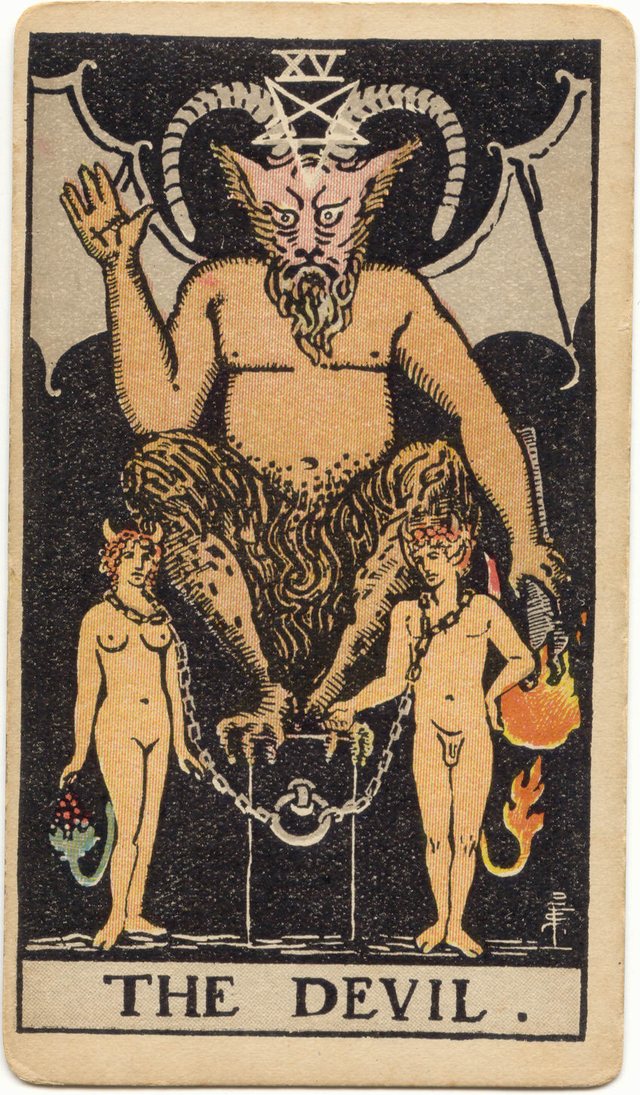
A horned figure with grey bat wings squats on a black block, his goat legs ending in bird claws. An upside-down pentagram sits above his brow, his right hand is raised with the palm open, and his left holds a flaming torch pointed down. Chained to a ring on the block stand a naked man and woman, each with small horns and a tail: his tipped with fire, hers with a bunch of grapes. Everything is set against solid black.
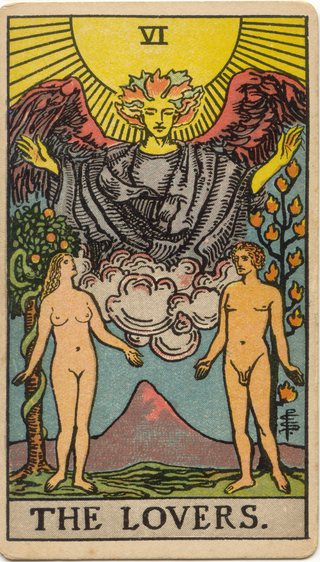
Look at the chains. They hang loosely around the two necks, wide enough to lift off. That detail carries the whole card. The Devil describes a bond that feels compulsory but is partly kept in place by the person wearing it: a habit, an addiction, a relationship, a job you hate but cannot imagine leaving, a fixation on status or money. The two figures recall the couple on card VI, the Lovers, now diminished and turned into a kind of property.
This is not a card of evil in the dramatic sense. It is about appetite and attachment, the ordinary hungers that become the centre of a life when nothing checks them. Naming the chain is the first step, and often a surprisingly powerful one. Many readers also see in it a frank acknowledgement of desire, which is not itself the problem.
The Devil reversed
Reversed, the Devil is often read as the moment the chains start to come off. You see the pattern clearly, admit what it costs, and begin to step away from it. That can feel exposing, because the habit or relationship was also a comfort, but there is relief in it too.
Other readers treat the reversal as a warning that the grip is loosening only on the surface, or that a compulsion has gone underground rather than away. Either way it is a good moment for honesty about what you depend on, and for asking for support if a pattern has become too strong to break alone.
In love and relationships
In love, the Devil can describe intense physical attraction, jealousy or a relationship that runs on dependence more than choice. It may be a bond that is hard to leave even though it brings out the worst in both people, or a pattern of control, financial or emotional. It can also simply point to strong desire, honestly enjoyed. For someone single, it can show attraction to people who are bad for you. Reversed, it often marks the start of untangling yourself from an unhealthy dynamic.
In work and purpose
At work the card fits golden handcuffs: a well-paid role that is slowly costing you, a culture of overwork that everyone pretends is normal, or a project you cling to for status. It can also describe ambition that has become an end in itself. The loose chains ask whether you are really as trapped as you feel or whether the cost of leaving is one you have never tested. Reversed, it suggests stepping back from an unhealthy pattern at work, even if gradually.
As advice
Name the thing you feel bound to, out loud if you can. Notice how loosely the chain actually sits, and what you get from keeping it on. Take one small step that proves to yourself you have a choice, and ask for help where a habit is stronger than you.
Yes or no?
No The Devil reads as no, or as a yes that would cost more than it gives, because it points to compulsion rather than free choice. How yes-or-no readings work here.
Questions to sit with
- What do I feel unable to live without, and is that really true?
- What does this habit or attachment give me that I am afraid to lose?
- Who would I be if I lifted this chain off?
Symbolism in the card
The horned figure
Half man, half goat, with curling horns, a heavy beard and bat wings. Waite called it 'the Horned Goat of Mendes', drawing on Éliphas Lévi's nineteenth-century Baphomet. It is less a personal devil than an image of instinct enthroned above reason.
The inverted pentagram
A white five-pointed star sits point-down above the brow. Upright, the pentagram is often read as spirit ruling the four elements; inverted, as matter and appetite ruling spirit, which is exactly the situation the card describes.
The raised hand
The right hand is lifted with the palm open and the fingers spread. Waite called it 'the reverse of that benediction' given by the Hierophant. It looks like a blessing, but it is a gesture of command.
The downturned torch
In the left hand a lit torch points towards the ground, close to the man's flaming tail. A torch held up gives light; turned down, its fire is spent on lower things, the energy of desire without direction.
The chains and ring
Chains run from a ring on the front of the block to loops around both figures' necks. The loops are loose and wide. The figures could lift them off, which makes the card about consent to captivity as much as captivity itself.
The two chained figures
A naked woman and man, each with small horns, stand on either side. Her tail ends in a cluster of grapes, his in a flame. They echo the couple of the Lovers, card VI, now marked by appetite and bound to it.
The black block
The Devil perches on a black half-cube with a white outline, gripping it with bird claws. Waite calls it an altar. A cube is often read as the material world, and here it is only half a cube: matter incomplete.
The black background
The whole scene is set against flat black. There is no landscape, no sky, no horizon: nowhere else to look. It is the visual opposite of the Lovers, who stand under a bright sun and an open sky.
“The figures are tailed, to signify the animal nature, but there is human intelligence in the faces, and he who is exalted above them is not to be their master for ever.”
Numbers, elements and astrology
Number 15, reduced to 6 (1 + 5): Six
Six restores harmony after the five's upset: generosity, recovery, sharing and passage onward.
Earth
Earth is the body, money, work, home and the slow growth of material things. The Golden Dawn tied The Devil to Capricorn, a sign of Earth.
These are the traditional attributions of the Hermetic Order of the Golden Dawn (1888), which Waite and Smith followed: each trump is matched to a Hebrew letter and to an element, planet or zodiac sign. They are a symbolic system, not astronomy. How we checked them.
A little history
No Devil survives from the Visconti-Sforza cards, though it appears in other early Italian lists of the trumps. The Tarot de Marseille shows Le Diable as a horned, bat-winged figure on a pedestal with two smaller horned imps tied to it by cords. Waite notes that after Éliphas Lévi, whose Baphomet drawing gave the figure a goat's head, a pentagram and a torch, the card changed character in occult circles. Smith's design follows that line and redraws the imps as a human couple who closely echo the Lovers card, a link most readers take as deliberate.