Major Arcana · VI
The Lovers
Upright love · union · a meaningful choice · alignment · honesty
Reversed disharmony · an avoided choice · misaligned values · temptation
- Arcana
- Major
- Number
- VI
- Element
- 🜁 Air
- Astrology
- ♊ Gemini
- Hebrew letter
- Zayin ז
- Yes or no
- Yes
The Lovers upright
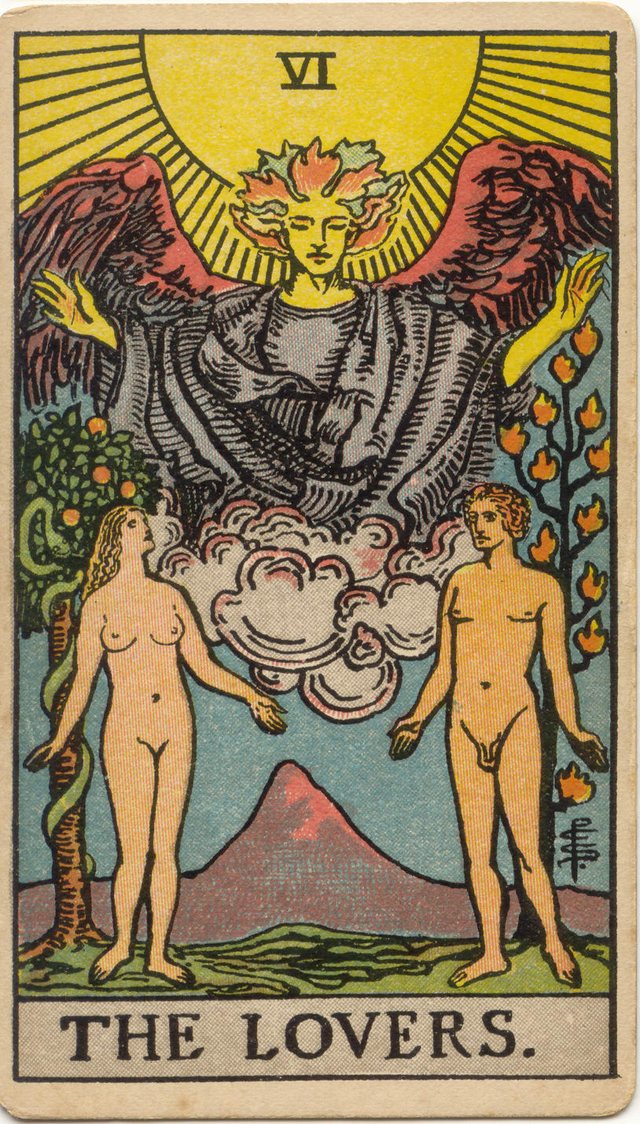
A great sun fills the top of the card, and beneath it an angel with flame-like hair and red-purple wings rises from a cloud, arms spread over two figures below. A naked woman stands on the left and a naked man on the right. Behind her grows a fruit tree with a serpent coiled round its trunk; behind him, a tree whose leaves are flames. Between them, in the distance, rises a single mountain.
Smith's image is a picture of Eden before the fall: two people standing open before each other, watched over and blessed. At its simplest this is the card of love and attraction, the recognition of another person and the vulnerability of being seen. Notice where they look. The man looks at the woman, and the woman looks up at the angel. The card suggests a love that connects people to something larger than either of them.
The Lovers is also a card of choice, the meaning older decks stressed most. The serpent's tree stands right behind the woman. Real love involves decisions about commitment, honesty and what we value, and the card often appears when a choice needs to come from the whole self rather than impulse or habit. Whether the question is a relationship or something else entirely, it asks what you truly want and whether your actions match it.
The Lovers reversed
Reversed, the Lovers often points to imbalance in a relationship: one person giving more, communication breaking down, or attraction without real connection. It can describe a split between head and heart, or values that have quietly drifted apart.
As a card of choice, the reversal can mean avoiding a decision, making one for the wrong reasons, or being pulled by temptation against your better judgement. It may also turn inward: not a problem with a partner, but a gap between who you are and how you are living. Readers differ on the details, but most agree the card asks for honesty first.
In love and relationships
This is the card most people hope to see in a love reading, and upright it is warm: mutual attraction, deep connection, a relationship built on choice rather than convenience. It can mark a step into commitment or a moment when two people see each other clearly. It also asks for honesty, since intimacy goes only as deep as what you are willing to show. Reversed, it may describe mismatched values, a third person complicating things, or a relationship one of you stays in out of habit.
In work and purpose
At work the Lovers rarely means romance. More often it points to a significant decision, a partnership or a question of values: an offer that pays well but sits uneasily, a collaboration that works because both sides want the same thing. It favours bringing your work into line with what you care about. Reversed, it can describe a partnership under strain, a conflict between what you are asked to do and what you believe, or a choice put off until it makes itself.
As advice
Choose from the whole of yourself. Be honest about what you want and about the values you will not give up, and let both guide the decision in front of you. Where another person is involved, meet them openly; real connection needs both people to be seen.
Yes or no?
Yes The Lovers favours union and wholehearted choices, so it reads as yes when your heart and your values agree. How yes-or-no readings work here.
Questions to sit with
- What do I truly value here, beyond what I want in the moment?
- Where am I hiding part of myself from someone close to me?
- Which choice would I make if I trusted myself completely?
Symbolism in the card
The angel
A large winged figure with hair like flames and a grey-purple robe rises from a pink-edged cloud, arms spread in blessing. It is often identified as the archangel Raphael, though Waite does not name it. Its presence makes the union sacred, seen and approved from above.
The sun
A huge yellow sun fills the top of the card behind the angel's head, its rays reaching to the edges. It is the light of clarity and consciousness: nothing between these two people is hidden.
The two figures
A naked woman and man stand apart on open ground, the woman on the left and the man on the right, hands open. Their nakedness is innocence rather than display. Waite calls them 'unveiled before each other', like Adam and Eve in paradise.
The tree and the serpent
Behind the woman stands a leafy tree with round orange fruit and a green serpent coiled up its trunk. This is the Tree of the Knowledge of Good and Evil: temptation, choice and the knowledge that comes with experience.
The tree of flames
Behind the man rises a slender tree whose leaves are drawn as flames. Waite calls it the Tree of Life bearing twelve fruits, which readers often link to the twelve signs of the zodiac. The flames suggest passion and living spirit.
The mountain
A single reddish peak rises between them in the distance, pointing straight up towards the angel. It can be read as a challenge the couple face together, or as the height of a shared aim.
“This is in all simplicity the card of human love, here exhibited as part of the way, the truth and the life.”
Numbers, elements and astrology
Number 6: Six
Six restores harmony after the five's upset: generosity, recovery, sharing and passage onward.
Air
Air is thought, speech, truth and conflict: the mind and its sharp edges. The Golden Dawn tied The Lovers to Gemini, a sign of Air.
These are the traditional attributions of the Hermetic Order of the Golden Dawn (1888), which Waite and Smith followed: each trump is matched to a Hebrew letter and to an element, planet or zodiac sign. They are a symbolic system, not astronomy. How we checked them.
A little history
In the fifteenth-century Italian decks the Lovers is a courtly scene: a couple joined in betrothal beneath a blindfolded Cupid. The Tarot de Marseille's L'Amoureux shows a young man standing between two women, with Cupid aiming an arrow from above, and later writers read it as a choice between virtue and vice. Waite dismissed that reading as one of the 'later follies'. Smith's design replaces the trio with a single couple modelled on Adam and Eve in Eden, under an angel and a blazing sun, which moves the card's weight from temptation towards union.