Major Arcana · XVI
The Tower
Upright sudden upheaval · revelation · collapse of a false structure · release
Reversed delayed reckoning · fear of change · a narrow escape · slow collapse
- Arcana
- Major
- Number
- XVI
- Astrology
- ♂ Mars
- Hebrew letter
- Peh פ
- Yes or no
- No
The Tower upright
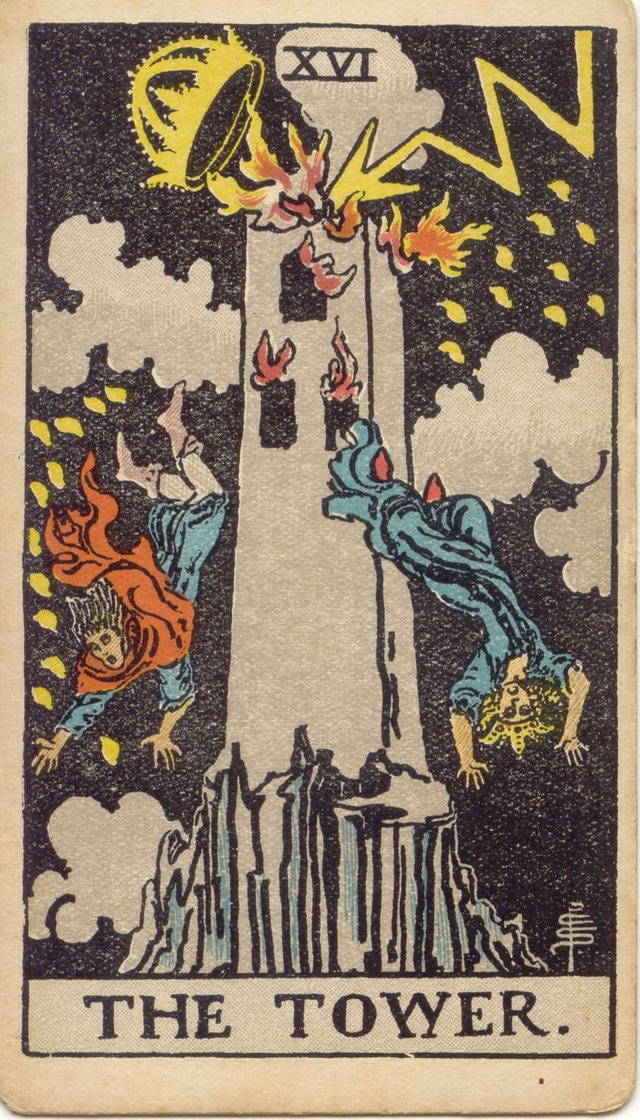
A tall grey tower stands on a lonely crag, and lightning has knocked its crown clean off. Fire pours from the windows and two people fall headfirst into the dark. It is the most abrupt image in the deck, and most people who draw it feel a jolt before they have read a word.
The jolt is the point. The Tower is about the moment a structure you relied on turns out to have been built on a false premise: a plan, a belief about yourself, a relationship's unspoken bargain, a job you thought was secure. Nothing in the card suggests the tower was struck at random. It was tall, isolated and closed; the lightning simply found it. Read this way, the card is less about disaster than about exposure: what was hidden or propped up comes into the open, quickly, and without your permission.
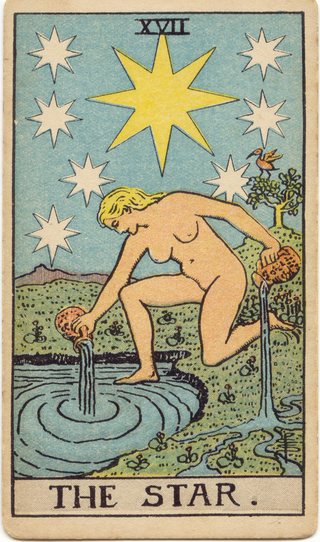
That is uncomfortable, and the card does not pretend otherwise. But the falling figures are not the end of the story. Once the crown is gone, there is nothing left to defend, and the next cards in the Major Arcana are the Star, the Moon and the Sun. Many readers treat the Tower as the necessary clearing that makes the quieter hope of the Star possible.
The Tower reversed
Reversed, the Tower often describes upheaval that is being held off rather than avoided. You may sense the cracks and keep plastering over them, or keep a situation standing out of fear of what the rubble would mean. The cost of that delay is usually tension: the collapse becomes slow and grinding instead of sudden.
Some readers take the reversal more gently, as a close call or a shake-up that is milder than feared, or as change that happens inwardly before it shows outside. Either way the question it raises is the same: what are you working hard to keep upright, and would it be better to let it come down on your own terms?
In love and relationships
In love, the Tower points to a moment of truth: an argument that finally says the thing nobody had said, a discovery, or a realisation that the relationship rests on an arrangement one of you has outgrown. It does not decide whether the relationship survives. Plenty of couples come through a Tower moment more honest than before. For someone single, it can mark the end of an old pattern, such as being drawn to the same kind of unavailable partner, that suddenly becomes impossible to ignore.
In work and purpose
At work the card fits restructurings, a project that falls apart, a sudden resignation or an idea that overturns how things were done. It can also describe an inner shift: the day you realise a career path no longer fits. If you are the one building, it asks whether your plans depend on an assumption you have never tested. Better to find the weak foundation in a meeting room than in a crisis.
As advice
Let what is already falling fall. Spend your energy on getting clear and getting safe, not on defending a position that has stopped being true. Once the dust settles, notice what is still standing: that is what you can actually build on.
Yes or no?
No The Tower describes disruption and the end of a plan as it stood, so it reads as a no, or a not-like-this. How yes-or-no readings work here.
Questions to sit with
- What in my life is being held up by effort rather than by its own foundations?
- If this structure came down tomorrow, what would I be relieved to be free of?
- What did I already know that I was avoiding saying out loud?
Symbolism in the card
The tower
Tall, grey and windowless except near the top, the tower stands alone on a jagged peak. It is a picture of ambition and of isolation: something built high, closed off and difficult to reach. Waite called it a 'House of Falsehood', the structure that was never sound.
The lightning bolt
A zigzag of lightning strikes from the upper right. In the Smith drawing it ends in a point at the crown, as if aimed. Lightning is the classic image of insight or force from outside that cannot be negotiated with: illumination and destruction in the same instant.
The falling crown
The golden crown that capped the tower is knocked off and tumbles sideways. A crown is authority and certainty; losing it here suggests that the idea which ruled the whole structure is the first thing to go.
The two falling figures
On the left a bareheaded figure in a red cloak, on the right a crowned one in blue: both fall headfirst, hands out. They have been read as the two halves of a person (pride and reason, or the ruler and the ruled) and by Waite as 'the literal word made void and the other its false interpretation'.
The flames in the windows
Fire bursts from the top windows. Once the structure is breached, the energy inside it comes out: the card is about release as well as damage.
The yellow drops
Small yellow flames shaped like the Hebrew letter yod fall on both sides, traditionally counted as twenty-two, the number of the Major Arcana. Many readers take them as divine sparks: grace falling into the scene along with the wreckage.
The dark sky and grey clouds
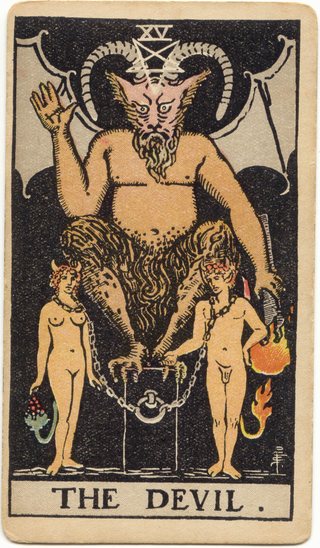
The background is almost black, with heavy grey clouds. Like the Devil just before it, the Tower is set against black: unlike the yellow skies of the more hopeful cards, nothing here is calm.
“I agree rather with Grand Orient that it is the ruin of the House of Life, when evil has prevailed therein, and above all that it is the rending of a House of Doctrine.”
Numbers, elements and astrology
Number 16, reduced to 7 (1 + 6): Seven
Seven is the number of testing and reflection: the point mid-way where results are weighed, and imagination, doubt or courage are asked for.
These are the traditional attributions of the Hermetic Order of the Golden Dawn (1888), which Waite and Smith followed: each trump is matched to a Hebrew letter and to an element, planet or zodiac sign. They are a symbolic system, not astronomy. How we checked them.
A little history
The lightning-struck tower appears in the earliest surviving printed tarots, though not in the hand-painted Visconti-Sforza cards of the fifteenth century, where it is missing from the surviving set. Early Italian sources name it the House of the Devil or simply the Arrow; the Tarot de Marseille calls it La Maison Dieu, the House of God, a title that has puzzled commentators for centuries. Smith's version keeps the Marseille composition of falling figures and scattered drops, turns the toppling top of the tower into an unmistakable golden crown and sets the whole building on a jagged crag.