Major Arcana · XX
Judgement
Upright awakening · calling · reckoning · renewal · absolution
Reversed self-doubt · ignoring the call · harsh self-judgement · hesitation
- Arcana
- Major
- Number
- XX
- Element
- 🜂 Fire
- Astrology
- 🜂 Fire (element)
- Hebrew letter
- Shin ש
- Yes or no
- Yes
Judgement upright
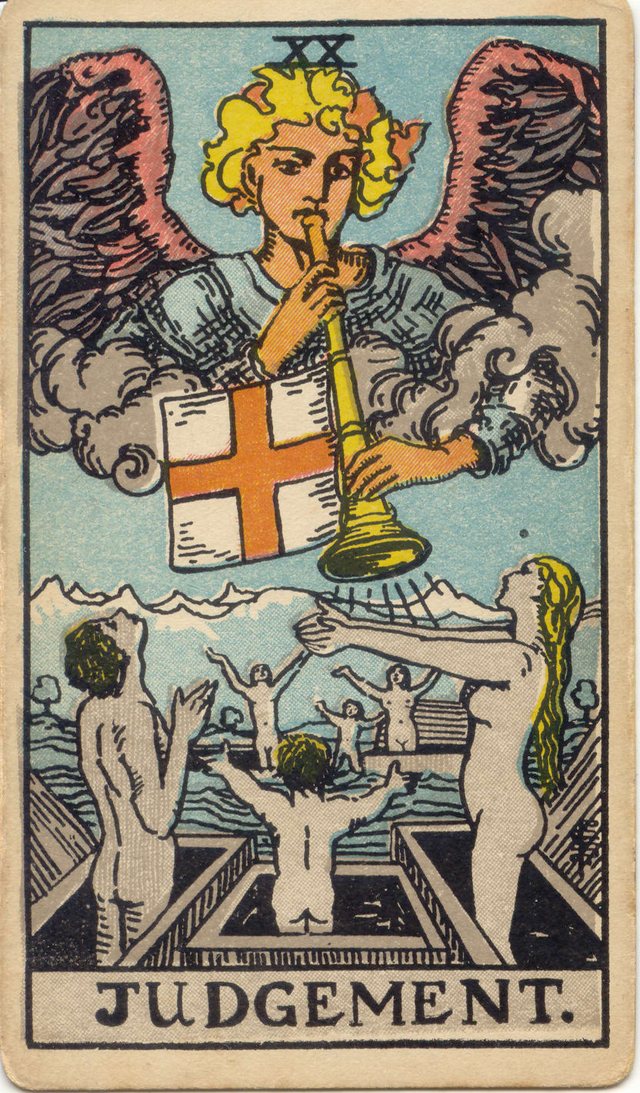
A great angel leans out of grey clouds and blows a long gold trumpet, from which hangs a white banner marked with a red cross. Fine lines of sound spread down from the bell. Below, on a grey-blue sea backed by white mountains, open coffins float on the water, and grey-skinned people rise from them with arms raised. In front a man faces the angel with his hands lifted, a woman with long fair hair opens her arms, and between them a child, seen from behind, reaches up.
The image is the Last Judgment, but the card is rarely read as a verdict handed down from outside. It is about hearing a call and answering it. Something wakes you up: a realisation, a moment of clarity, a sense of what you are meant to do next. The people in the coffins have not done anything to earn the trumpet. They simply rise when they hear it.
In practice Judgement often marks a turning point where you review your life honestly, accept what has happened without endless self-blame, and decide to begin a new chapter on a firmer footing. It can describe a vocation becoming clear, forgiveness given or received, or the decision to stop living as a smaller version of yourself.
Judgement reversed
Reversed, Judgement can show a call that is being ignored: you know what needs to change, but doubt or fear keeps you in the coffin. It may also point to harsh self-judgement, replaying old mistakes so often that it becomes impossible to move on from them.
Some readers see the reversal as a reckoning that is delayed by distraction, or a decision taken without honest reflection first. The question it raises is simple and uncomfortable: what are you hearing that you are pretending not to hear, and what would it take to forgive yourself enough to answer it?
In love and relationships
In love, Judgement describes a moment of reckoning: looking honestly at a relationship and deciding together what it will become. It can mean renewal after a separation, forgiveness after a hurt, or recognising that a relationship has run its course and choosing that ending with clarity. For someone single, it can mark an awakening about what you really need from a partner. Reversed, it may show old grievances being replayed, or fear of judgement keeping someone from committing.
In work and purpose
At work the card fits reviews and appraisals in the broadest sense: assessing what you have built so far and deciding where to go next. It often points to a calling, a sense that a different kind of work is asking for you, or to returning to a field you left. It suits decisions made with the whole picture in view. Reversed, it can show hesitation before a clear opportunity, or being too hard on yourself after a setback.
As advice
Listen for what is calling you, and answer it. Look honestly at the past, take what it has to teach, and then stop relitigating it. You are allowed to rise and begin again without waiting for permission, and without needing every past mistake resolved first.
Yes or no?
Yes Judgement reads as yes, especially when the question is about answering a call, renewing something or making a clear decision. How yes-or-no readings work here.
Questions to sit with
- What has been calling me that I have not yet answered?
- What would I need to forgive, in myself or another, to move forward?
- Looking back over this chapter, what am I ready to leave in the coffin?
Symbolism in the card
The angel with the trumpet
A large angel with curly golden hair and red and dark wings leans out of the clouds, blowing a long gold trumpet. The angel is often identified as Gabriel. The trumpet is a summons that cannot be ignored, heard by everyone at once.
The banner with the red cross
A square white banner with a red cross hangs from the trumpet. Waite notes that the cross 'as usual is displayed on the banner'. The equal-armed cross is often read as the meeting of opposites, spirit and matter, life and death.
The clouds
Thick grey clouds billow around the angel, who appears to emerge from them rather than descend. The call comes from a realm that is usually hidden, breaking through for a moment.
The rising figures
In front, a man on the left, a woman on the right and a child between them, its back to us. Behind them more figures rise from other coffins. Waite pointed out that this card shows 'more than three who are restored', so the call is universal.
The floating coffins
Rectangular open coffins float on the water rather than lying in the ground. Their lids are gone. A coffin is the fixed shape of a finished life; rising out of it means leaving behind an old self that had become a container.
The white mountains
Behind the sea rises a range of white, snow-covered peaks. Mountains often represent challenge and attainment; snowy ones, a cold, pure clarity. They recall the high country behind the Fool and the Lovers.
The raised arms
Nearly every figure lifts their arms or opens them towards the angel. Waite described them as 'one in the wonder, adoration and ecstacy' expressed by their attitudes. The response is not fear but welcome.
“What is that within us which does sound a trumpet and all that is lower in our nature rises in response—almost in a moment, almost in the twinkling of an eye?”
Numbers, elements and astrology
Number 20, reduced to 2 (2 + 0): Two
Two brings a second thing, and with it relationship, choice and balance. Twos are about pairs, partnerships and decisions between options.
Fire
Fire is will, energy, desire and creativity: the drive that starts things.
These are the traditional attributions of the Hermetic Order of the Golden Dawn (1888), which Waite and Smith followed: each trump is matched to a Hebrew letter and to an element, planet or zodiac sign. They are a symbolic system, not astronomy. How we checked them.
A little history
The resurrection scene is among the most stable in tarot. The Visconti-Sforza card shows trumpeting angels above figures rising from a tomb, with God the Father in the sky. The Tarot de Marseille calls it Le Jugement, numbered XX, with an angel blowing a bannered trumpet over three figures rising from a single grave. Waite titled it the Last Judgment in his text, while the card itself reads Judgement. Smith added more figures, the floating coffins and the white mountains. The Golden Dawn attributed the card to the element of fire.