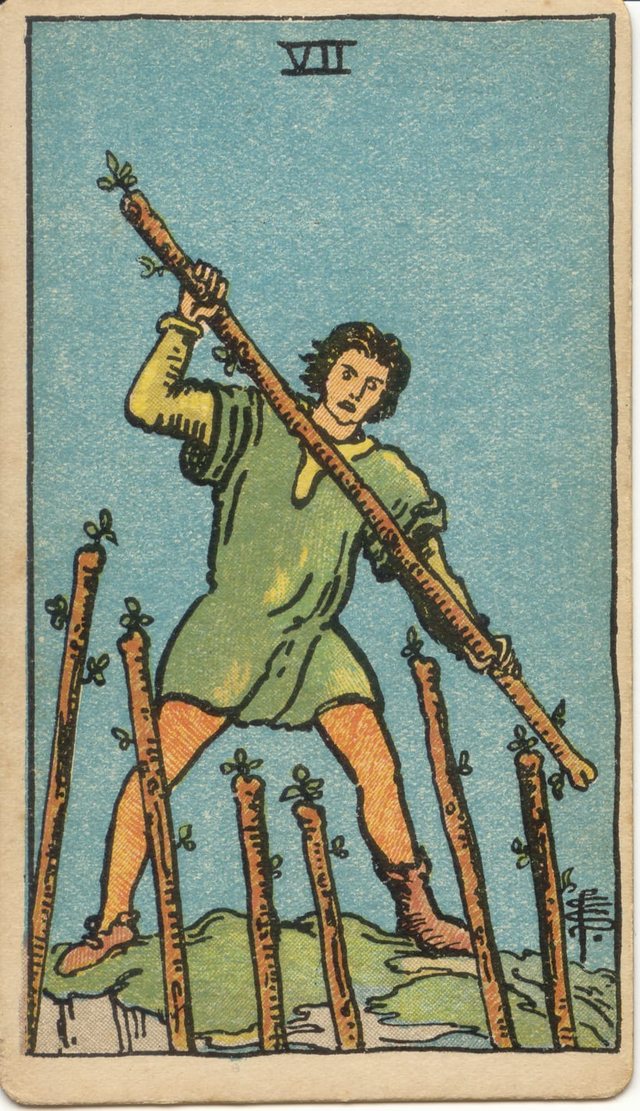
Seven of Wands
Upright standing your ground · conviction · defence · competition · perseverance
Reversed overwhelm · giving way · exhaustion · defensiveness
- Arcana
- Minor · pip card
- Number
- Seven
- Element
- 🜂 Fire
- Astrology
- ♂ Mars in ♌ Leo
- Golden Dawn title
- Lord of Valour
- Yes or no
- Yes
Seven of Wands upright
A young man in a green tunic stands on a grassy rise, gripping a wand across his body with both hands as if to block a blow. Six wands rise toward him from below the edge of the hill, and we never see who holds them. His face is strained, his mouth open. Look at his feet: they do not match. One wears a low shoe, the other an ankle boot.
Waite read the card as valour: six against one, but the one holds the vantage point. It is about defending a position, whether that is a belief, a decision, a role you have earned or a boundary someone keeps testing. The defender is outnumbered and visibly working hard, but the high ground is his. In competitive situations the card suggests you can keep your place if you stay alert and do not lose your footing.
The odd shoes are worth a second look. Many readers take them as a sign that he was caught unprepared, pulled into the fight before he could dress properly. That makes the card very human. Most of the stands we take are not planned; we grab whatever is nearest and defend it as best we can. Waite also linked it with debate and argument, a war of words as much as of sticks.
Seven of Wands reversed
Reversed, the pressure starts to tell. You may feel worn down by constant challenges, tempted to give up the position, or simply too tired to keep defending it. Sometimes that is wise: not every hill is worth holding.
Other readings point to defensiveness, treating every question as an attack, or to the indecision that Waite lists among the reversed meanings, along with anxiety and embarrassment. The useful question is whether you are defending something that matters or only defending your pride. If the cause is real, the reversal asks for rest and allies. If it is not, it may be time to come down.
In love and relationships
In love the Seven of Wands can describe protecting a relationship against outside pressure: disapproving relatives, rivals, gossip. It can also show one partner guarding their independence inside the relationship. If you keep having to justify your feelings, the card asks whether that effort is returned. Reversed, it may point to the fatigue of defending a relationship that does not defend you back, or to a defensiveness that keeps a partner at bay.
In work and purpose
At work this card fits competitive markets, pushing back against criticism, defending a proposal in a meeting, or holding on to a post others want. It suggests you have the advantage if you keep your nerve and know your case. It is also the card of the person who has risen and now has to cope with challengers. Reversed, it may describe burnout from constant conflict, or giving way on something you should have held.
As advice
Hold your ground if it is ground worth holding. Know exactly what you are defending and why. You do not have to answer every challenge at once: deal with the nearest one and keep your footing. And do not let an untidy start, the mismatched shoes, convince you that you have no right to stand there.
Yes or no?
Yes Waite calls this a card of success because the defender holds the high ground, so it reads as yes, though one that takes effort. How yes-or-no readings work here.
Questions to sit with
- What am I defending, and is it still worth defending?
- Am I responding to real challenges or to ones I expect?
- What would help me hold my position with less strain?
Symbolism in the card
The defender on the hill
A young man in a green tunic braces his legs on a grassy mound, his expression tense. He holds the higher ground, which Waite saw as the reason one can stand against six.
The six wands from below
Six leafy wands rise from beyond the edge of the hill, their bearers out of sight. Hidden opponents are a good image for pressure that seems to come from everywhere at once: criticism, competition, doubt.
The wand held across the body
He holds his own wand diagonally with both hands, one high and one low, in a guard rather than a strike. The posture is defensive: blocking and parrying, not attacking.
The mismatched shoes
One foot wears a low shoe, the other a brown ankle boot. The detail is usually read as haste, a man pulled into the fight before he was ready. It makes his stand improvised, and very human.
The green tunic
He wears a loose green tunic with yellow sleeves: workaday clothes, not armour. He is no soldier, which makes his stand more about conviction than training.
“It is a card of valour, for, on the surface, six are attacking one, who has, however, the vantage position.”
Numbers, elements and astrology
Seven
Seven is the number of testing and reflection: the point mid-way where results are weighed, and imagination, doubt or courage are asked for.
Fire: the suit of Wands
Fire is will, energy, desire and creativity: the drive that starts things.
By Golden Dawn tradition each numbered card from two to ten rules ten degrees of the zodiac (a decan): the Seven of Wands is Mars in the third decan of Leo. They are a symbolic system, not astronomy. How we checked them.
A little history
The Golden Dawn named this the Lord of Valour, the same word Waite chose to open his reading. Older decks give the Seven of Batons as seven staves with no figure, and Smith's lone defender is her own. The mismatched footwear has been noticed by generations of readers. Whether Smith meant it as a sign of haste is not recorded, but it is plainly drawn on the original card.