Five of Swords
Upright hollow victory · conflict · winning at any cost · humiliation · walking away
Reversed making amends · lingering resentment · ending a feud · regret
- Arcana
- Minor · pip card
- Number
- Five
- Element
- 🜁 Air
- Astrology
- ♀ Venus in ♒ Aquarius
- Golden Dawn title
- Lord of Defeat
- Yes or no
- No
Five of Swords upright
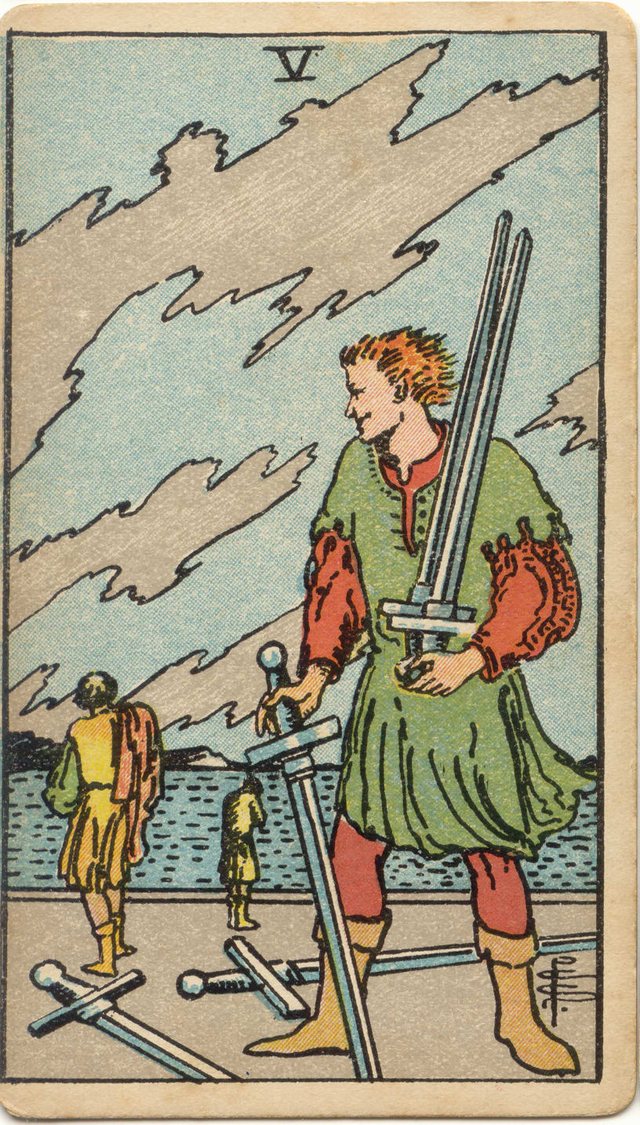
A young man with a shock of red hair stands in the foreground in a green tunic with red sleeves. He holds two swords upright against his shoulder and rests his other hand on a third, point down in the ground. Two more lie at his feet. He is looking back over his shoulder with a thin smile at two figures who walk away from him towards the water, one with a red cloak over his shoulder, the other small and stooped. The sky is torn by ragged grey clouds blowing across it.
Waite called him "the master in possession of the field", and the card is about exactly that: someone has won, and the winning has left a bad taste. The swords he gathers belonged to the others. You might be the one holding them, having won an argument or a contest in a way that cost goodwill. You might be one of the figures walking away, beaten and unwilling to keep fighting. Or you might be watching a conflict in which nobody is behaving well.
The card asks what the victory was for. Some fights are worth winning; others leave you with a pile of weapons and no one left to talk to. It can also recognise that walking away is sometimes the wisest move, a choice the departing figures may have made deliberately.
Five of Swords reversed
Reversed, the conflict is usually winding down. People may be ready to put the swords down, apologise or simply stop going over the same ground. The reversal can bring the chance to make amends, or the realisation that a grudge has outlived its reason.
It can also describe resentment that will not go away: an old defeat replayed in your head, or a fight that has ended in public but not in private. Waite gave the reversal the same meanings as the upright, with "burial and obsequies" added, so some readers treat it as the cost of the conflict being counted.
In love and relationships
In love, the Five of Swords points to arguments where winning matters more than understanding: point-scoring, saying the cruel thing because it is effective, or one partner always having the last word. It can also describe a breakup that leaves both people feeling defeated. The useful question is what you want more, to be right or to be close. Reversed, it may show the chance to apologise and reset, or a lingering hurt that still needs to be talked through.
In work and purpose
At work the card fits office politics, a promotion won by stepping on someone, a negotiation that gained the terms but lost the relationship, or a team where blame is passed around. It can also describe knowing when to concede a point you cannot win. If you have been on the losing side, it asks whether this battle deserves more of your energy. Reversed, it suggests clearing the air after a conflict, or noticing a pattern of competition that is costing everyone.
As advice
Ask what winning would actually get you. If the price is a relationship, your reputation or your own peace, it may be better to let this one go. And if you have already won, consider handing something back: generosity after a fight is rarer, and usually remembered longer.
Yes or no?
No Any yes here would come at a cost to someone, so the card generally reads as no, or not in this way. How yes-or-no readings work here.
Questions to sit with
- What am I trying to win here, and what will it cost?
- Have I been the one gathering the swords, or the one walking away?
- Is there a conflict I could end by choosing not to have the last word?
Symbolism in the card
The smiling victor
The red-haired young man in green and red looks back at the others with a slight, knowing smile. Waite called him 'disdainful'. He is the picture of self-interest: someone who got what he wanted and is watching the cost walk away.
The gathered swords
He holds two swords against his shoulder and grips the hilt of a third, while two more lie on the ground. Collecting the weapons of the defeated is a mark of total victory, but also of having more than anyone can use.
The two retreating figures
In the middle distance two people walk away towards the water, backs turned. One carries a red cloak over his shoulder; the other is smaller and bowed, perhaps with a hand to the face. They are defeat and grief, and also the choice to leave.
The torn clouds
Jagged grey clouds streak diagonally across a pale blue sky, as if blown apart by wind. Air is the suit's element, and here it is turbulent: a mental storm, tempers still high after the fight.
The water and far shore
Behind the figures a band of grey-blue water meets a dark low shore. The losers are heading towards it, and water often marks a boundary to cross or a place where feeling takes over from argument.
“A disdainful man looks after two retreating and dejected figures. Their swords lie upon the ground.”
Numbers, elements and astrology
Five
Five breaks the square. It brings disruption, conflict and loss, the necessary instability that keeps a story moving. Most tarot fives are hard cards.
Air: the suit of Swords
Air is thought, speech, truth and conflict: the mind and its sharp edges.
By Golden Dawn tradition each numbered card from two to ten rules ten degrees of the zodiac (a decan): the Five of Swords is Venus in the first decan of Aquarius. They are a symbolic system, not astronomy. How we checked them.
A little history
In older decks the five of swords is a pattern card with no figures. The Golden Dawn titled it the Lord of Defeat, and Waite's divinatory meanings, "degradation, destruction, revocation, infamy, dishonour, loss", follow the older French tradition he inherited. Smith turned that list into a scene of a single winner and two losers, which shifted the card from simple defeat to the more complicated question of what victory costs.