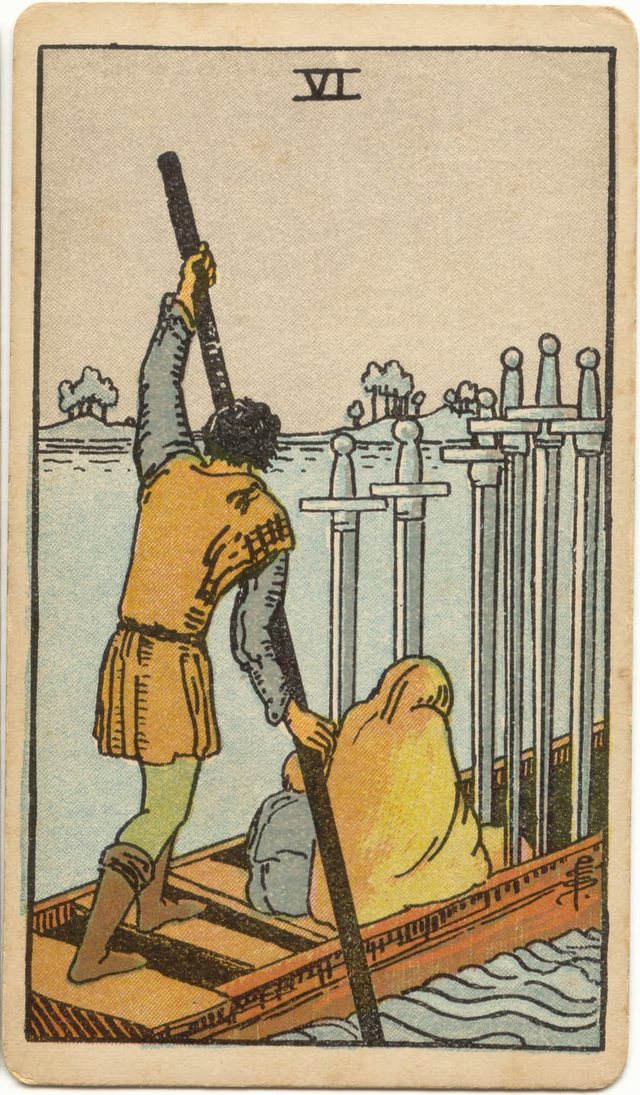
Six of Swords
Upright transition · moving on · recovery · safe passage · leaving difficulty behind
Reversed unable to move on · a stalled transition · unfinished business · returning to trouble
- Arcana
- Minor · pip card
- Number
- Six
- Element
- 🜁 Air
- Astrology
- ☿ Mercury in ♒ Aquarius
- Golden Dawn title
- Lord of Earned Success
- Yes or no
- Yes
Six of Swords upright
A flat-bottomed boat crosses the water, and we see it from behind. A ferryman in an orange tunic stands at the stern, pushing it along with a long black pole. In front of him a figure huddles under a yellow hooded cloak, and beside her sits a smaller figure in grey, often read as a child. Six swords stand upright in the bow. Near us the water is rippled; ahead it lies smooth, and on the far shore there are trees and a low hill.
This is the suit's card of moving on. It does not show a triumph or an escape so much as a quiet, necessary passage away from something painful: a move, a change of job, the end of a relationship, the slow walk out of a difficult year. The passengers are bowed and wrapped up. They are not celebrating. But they are going, and someone capable is steering.
Waite noted that "the freight is light" and the work "not beyond his strength". That is the card's comfort. The swords come with you, since the thoughts and memories of a hard time do not vanish at the shoreline, yet the load is manageable and the water ahead is calmer than the water behind. Accepting help, or being the steady one for someone else, is part of the reading.
Six of Swords reversed
A reversed Six often describes a crossing that is delayed or harder than hoped. You may want to leave a situation but feel unable to, or find yourself drifting back towards the troubles you meant to leave. Sometimes the reversal suggests unfinished business that needs attention before you can go.
Waite gave the reversal quite different meanings, "declaration, confession, publicity", and some readers use that: something private comes into the open. Others read the reversed card simply as resistance to a change that is already under way. The boat is moving whether or not you face forward, and looking back too long makes the crossing harder than it needs to be.
In love and relationships
In love, the Six of Swords can describe moving on from a breakup, leaving a relationship that was not working, or a couple getting through a rough patch together and coming out somewhere steadier. It may also describe a relationship that involves moving house or distance. The tone is gentle rather than dramatic: healing that happens gradually. Reversed, it may point to someone who has left in body but not yet in mind, or to old patterns following you into something new.
In work and purpose
At work the card suits a transfer, a career change, leaving a toxic workplace, or a team steering through a difficult transition to a more stable phase. It can also point to work involving travel, or a mentor who helps you across. The emphasis is on steady progress, not speed. Reversed, it may show a move that keeps being postponed, or the sense that the same problems have followed you into a new role.
As advice
Keep moving, slowly if you need to. You do not have to be over the past to leave it behind, and you can take the hard memories with you as long as you keep steering. Let someone else take the pole for a while if they offer.
Yes or no?
Yes The card shows a passage towards calmer water, so it reads as a quiet yes, especially to questions about leaving or changing. How yes-or-no readings work here.
Questions to sit with
- What am I ready to leave behind, even if I still feel its weight?
- Who is helping me across, and have I let them?
- What would the calmer shore look like for me?
Symbolism in the card
The ferryman
A man in an orange tunic and grey sleeves stands at the back of the boat, poling it forward with a long black pole. He is the steady guide or helper: competent effort that moves you through a transition you could not manage alone.
The cloaked passenger and the child
A figure wrapped in a yellow hooded cloak sits bowed in the boat, with a smaller figure in grey beside her. Their faces are hidden. They carry the grief or weariness of what they are leaving, and their trust in the ferryman.
The six swords in the bow
Six swords stand upright in the front of the boat, close to the passengers. They travel with them: the thoughts, memories and lessons of a hard time, not discarded but carried along.
The boat
A plain wooden punt crosses from one side to the other. Boats belong to crossings and thresholds: in many traditions a crossing by water marks a passage from one state of life to another.
Rough water and smooth water
On the right, near the viewer, the water is drawn in curling ripples; further out it lies flat and calm. Many readers take the contrast as the card's message: the troubled stretch is behind, the quieter one ahead.
The far shore
Across the water lies a low bank with a few round-topped trees and a gentle rise. It is not grand, but it is solid ground, the modest destination of a recovery rather than a dramatic new world.
“A ferryman carrying passengers in his punt to the further shore. The course is smooth, and seeing that the freight is light, it may be noted that the work is not beyond his strength.”
Numbers, elements and astrology
Six
Six restores harmony after the five's upset: generosity, recovery, sharing and passage onward.
Air: the suit of Swords
Air is thought, speech, truth and conflict: the mind and its sharp edges.
By Golden Dawn tradition each numbered card from two to ten rules ten degrees of the zodiac (a decan): the Six of Swords is Mercury in the second decan of Aquarius. They are a symbolic system, not astronomy. How we checked them.
A little history
Earlier decks show the six of swords as a pattern of blades without a scene. Smith's ferry picture seems to grow out of the traditional meanings Waite gives first, "journey by water, route, way", and she turned them into one of the deck's most quietly affecting images. The Golden Dawn title, Lord of Earned Success, sits rather oddly beside this subdued crossing.