Major Arcana · XIII
Death
Upright endings · transition · letting go · transformation · closing a chapter
Reversed resisting change · lingering · stagnation · a slow ending
- Arcana
- Major
- Number
- XIII
- Element
- 🜄 Water
- Astrology
- ♏ Scorpio
- Hebrew letter
- Nun נ
- Yes or no
- No
Death upright
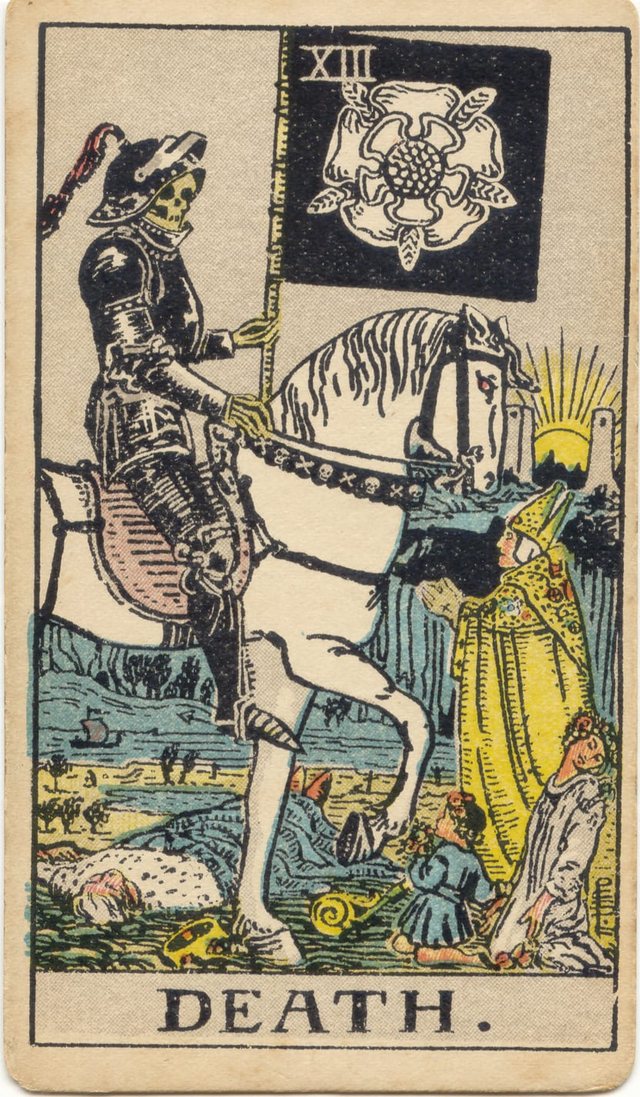
A skeleton in black armour rides a pale horse across the field from left to right, carrying a black banner marked with a white five-petalled rose. Before him a king lies fallen with his crown beside him, a bishop in gold vestments stands with his hands pressed together, a young woman kneels and turns her face away, and a child looks up holding a few flowers. Far off, a boat moves down a river and the sun shows between two towers on the horizon.
Almost nobody who reads tarot takes this card literally, and it is rarely about physical death. It is about endings: the kind that arrive whether or not you are ready, and that treat king and child alike. A role finishes, a relationship runs its course, a stage of life closes. The figures show the range of human responses, from collapse to pleading to looking away to plain acceptance, and the rider keeps moving through all of them.
What the card adds is direction. The horseman is going somewhere, and the sun on the horizon is either rising or setting depending on how you read it. Many readers see a clearing of ground: what has had its time is removed so that something else can grow. The grief is real, and so is the space it leaves.
Death reversed
Reversed, Death often describes an ending that is being resisted. Something is clearly over, but you keep it on life support out of habit, fear or loyalty, and the situation goes stale rather than resolving. The change that would have been clean becomes slow and draining.
Some readers see the reversal as a transition that is happening inwardly first, or a near-ending that has been postponed. The questions underneath are practical: what have you already outgrown, and what is the cost of pretending you have not? Letting go deliberately, on a day you choose, is usually gentler than having it taken from you later.
In love and relationships
In love, Death marks the end of something, though not always the relationship itself. It may be the end of the honeymoon phase, of an old way of relating, or of a hope that the other person will change. Sometimes it is the end of the relationship, and the card asks you to let that be true rather than drift. For someone single, it can mark finally letting go of a past partner. Reversed, it often shows someone clinging to a bond that has already ended in all but name.
In work and purpose
At work Death fits a role being phased out, a project closed, a department reorganised, or the moment you know a career path has finished for you. It favours finishing things properly: handovers, goodbyes, the last report. It can also describe retiring an old method or product so that energy can move to something with a future. Reversed, it suggests a job or plan kept going long past its natural end because nobody wants to be the one to call it.
As advice
Accept that this chapter is closing. Mark the ending honestly, grieve what needs grieving, and stop spending energy keeping alive what has already finished. Clear the ground, then look towards the light on the horizon. You do not have to know yet what will grow there.
Yes or no?
No Death closes a chapter, so it usually reads as a no to keeping things as they are, and a yes only to letting go. How yes-or-no readings work here.
Questions to sit with
- What in my life has already ended, even if I have not admitted it?
- Which of the figures before the horse am I most like right now?
- What would grow in the space if I let this go?
Symbolism in the card
The armoured skeleton
Death is a skeleton in black plate armour with a red-plumed helmet, holding the reins and banner but no scythe or weapon. Armour makes him impersonal and unstoppable; Waite noted that he 'carries no visible weapon', so he does not need to strike.
The white horse
A tall pale horse with a red eye steps forward, its bridle decorated with small skulls and crossbones. The image echoes the pale horse of the Book of Revelation. White is also a colour of purity, which softens the card's terror.
The black banner with the white rose
The flag is black with a large white five-petalled rose, a design also seen in heraldry. Waite called it the Mystic Rose, signifying life. Death carries the emblem of life on his banner: endings and renewal on the same flag.
The fallen king
A king lies on his back in the lower left, his crown on the ground beside him. Rank and power make no difference here: the first figure in the procession to fall is the one who seemed to have the most.
The bishop, maiden and child
A bishop in a gold mitre and vestments faces the rider with hands joined, a kneeling young woman turns her head aside, and a small child looks up with flowers in hand. They read as three responses to change: pleading, avoidance and simple openness.
The sun between two towers
On the far right a sun shines on the horizon between two pale towers. Waite called it 'the sun of immortality'. Whether rising or setting, it places the ending inside a larger cycle, and the towers recall the gateway on the Moon card.
The river and boat
A blue river crosses the landscape with a small boat on it. Rivers have long stood for passage between states, and ancient myth often places a boat at the crossing to the next world.
“The mysterious horseman moves slowly, bearing a black banner emblazoned with the Mystic Rose, which signifies life. Between two pillars on the verge of the horizon there shines the sun of immortality.”
Numbers, elements and astrology
Number 13, reduced to 4 (1 + 3): Four
Four is the square: stability, structure and rest, with the risk of standing still. Fours in tarot often show something held in place.
Water
Water is feeling, intuition, relationships and the imagination. The Golden Dawn tied Death to Scorpio, a sign of Water.
These are the traditional attributions of the Hermetic Order of the Golden Dawn (1888), which Waite and Smith followed: each trump is matched to a Hebrew letter and to an element, planet or zodiac sign. They are a symbolic system, not astronomy. How we checked them.
A little history
Death is the thirteenth trump in almost every early sequence. Fifteenth-century Italian cards show a skeleton, and the Tarot de Marseille shows a skeleton with a scythe mowing a field in which heads, hands and feet lie scattered, one head crowned. On many Marseille cards XIII carries no title at all, and French writers have called it the nameless arcanum. Smith's design breaks with the reaper. Following Waite, she drew an armoured rider on a white horse in the spirit of the apocalyptic horsemen, with a rose banner, figures of every rank and a sun on the horizon.