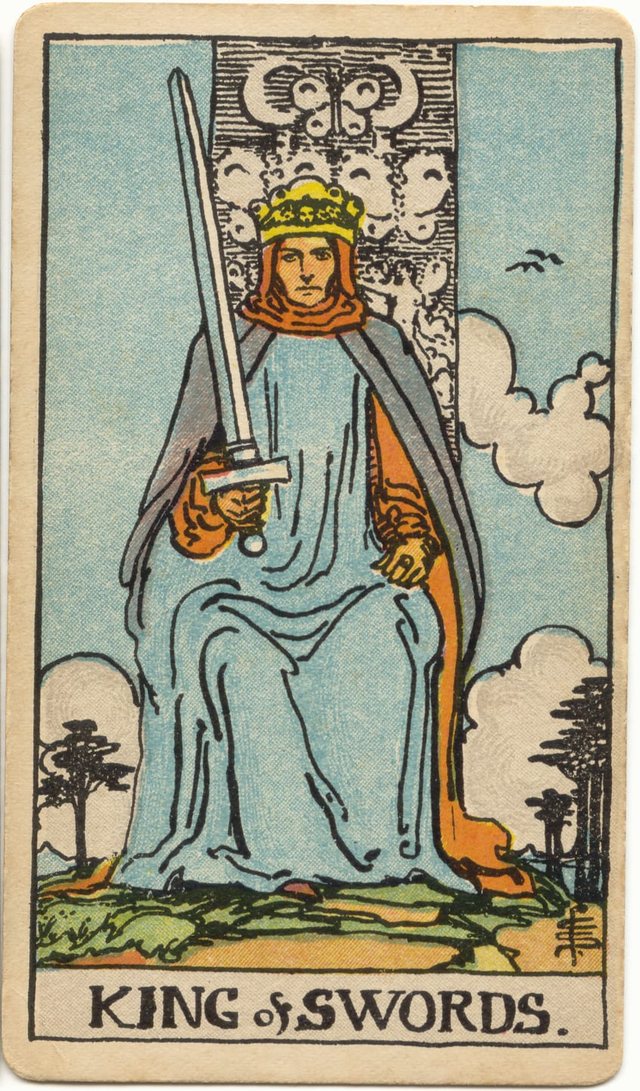
King of Swords
Upright intellectual authority · fairness · clear judgement · ethics · expertise
Reversed manipulation · abuse of power · cold logic · rigidity · harsh decisions
- Arcana
- Minor · court card
- Number
- King
- Element
- 🜁 Air
- Sub-element
- Fire or Air of Air (varies)
- Yes or no
- Yes
King of Swords upright
The king sits squarely facing us, looking straight out of the card. He holds a long sword in his right hand, tilted slightly away from his body, while his left hand rests on his knee. He wears a gold crown over an orange hood, a long pale blue robe and a grey-violet cloak. The tall back of his throne is carved with a butterfly between two crescent moons, with more butterflies below. Low clouds and dark trees stand on either side, and two birds fly in the sky to the right.
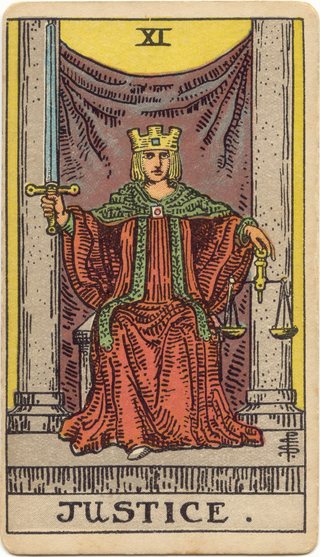
This is the suit's authority figure, the mind in full command. The King of Swords decides by principle rather than mood, weighs evidence before acting and accepts the responsibility of having the last word. Waite saw him as recalling Justice but stressed that he is "rather the power of life and death, in virtue of his office". As a person, he might be a judge, a senior professional, a demanding teacher, or anyone whose judgement others rely on.
As an approach, the card favours fairness, logic and plain speech: set the feelings aside long enough to see what is right. Its challenge is that reason alone can be cold. The best version of this king pairs his clear standards with an awareness of the people affected by them.
King of Swords reversed
Reversed, authority loses its fairness. Intelligence is used to manipulate rather than clarify, rules are applied rigidly or selectively, and power serves the person holding it. Waite's reversed meanings were "cruelty, perversity, barbarity, perfidy, evil intention".
More mildly, the reversal can show indecision in someone who is supposed to lead, or logic used to avoid emotion. Waite's extra note advises "a caution to put an end to a ruinous lawsuit", which some readers broaden to: stop pursuing a fight that only drains everyone. Being technically right is not always worth what it costs to prove it.
In love and relationships
In love, the King of Swords brings honesty, standards and a preference for clear agreements over emotional drama. He can describe a partner who is reliable and principled but reserved, or a moment when a relationship needs straight talking and fair compromise. If you find it hard to be heard, he suggests stating your needs plainly. Reversed, he may point to coldness, controlling behaviour or a partner who argues to win rather than to understand.
In work and purpose
At work the card fits leadership based on expertise, making a fair decision under pressure, setting clear policy or giving an expert opinion. It suits law, academia, consulting and analysis. If you are the one in charge, it asks you to be transparent about how decisions are made. Reversed, it may describe a manager who abuses authority, a rigid bureaucracy, or decisions made without regard for the people affected.
As advice
Decide by principle, not by pressure. Gather the facts, weigh them fairly and say your conclusion clearly, even if it is unpopular. Hold yourself to the same standard you apply to others. Even a fair judgement has to be delivered with some humanity.
Yes or no?
Yes The king delivers a clear, reasoned verdict, so the card reads as yes when the decision is logical and fair. How yes-or-no readings work here.
Questions to sit with
- What would I decide if I looked only at the facts?
- Am I applying the same standards to myself as to others?
- Where has my logic become a way to avoid feeling something?
Symbolism in the card
The sword held slightly off true
The king's sword is long and upright, but tilted slightly away from his body, unlike the perfectly vertical blade of Justice. Some readers see in this the human element in judgement: authority exercised by a person, not an abstraction.
The direct gaze
He faces straight out of the card, meeting the viewer's eye. It suggests openness, accountability and a judgement delivered in the open.
The throne with butterflies and crescents
The tall back of his throne is carved with a butterfly between two crescent moons at the top, and more butterfly shapes below. Butterflies belong to air and to the soul, crescents to the moon and to change.
Thrones in tarotButterflies in tarotCrescent and full moon in tarot
The crown and hood
He wears a gold crown over an orange hood that frames his face. The crown marks his authority; the close hood gives him the look of a judge or scholar rather than a warrior.
The blue robe and grey cloak
A long pale blue robe falls to his feet beneath a grey-violet cloak. Pale blue suits the clear sky of the suit's element, and the overall sobriety of the colours matches his measured character.
The two birds
Two small birds fly together in the sky to the right of his throne. Birds belong to air; a pair may suggest the balance of two sides weighed in judgement.
The clouds and trees
Low white clouds and dark trees stand on either side of the throne. He is set high and calm in his element, with weather and growth around but not above him.
“He recalls, of course, the conventional Symbol of Justice in the Trumps Major, and he may represent this virtue, but he is rather the power of life and death, in virtue of his office.”
Numbers, elements and astrology
King
Kings direct the suit outwardly: authority, responsibility and the mature use of its power.
Air: the suit of Swords
Air is thought, speech, truth and conflict: the mind and its sharp edges.
In the Golden Dawn system each court card is an element within its suit's element. Pages and Queens are agreed; Knights and Kings are Fire or Air depending on whether you follow the Golden Dawn's names or later practice. They are a symbolic system, not astronomy. How we checked them.
A little history
The King of Swords is the highest court card of the suit in the Tarot de Marseille, a crowned king with a sword. In the Golden Dawn scheme the mounted Knight was ranked as the king of the suit, with a Prince in a chariot below him, and how those titles map onto Waite's is still argued over. Waite returned to the older order of Page, Knight, Queen and King, and his additional meanings include "a lawyer, senator, doctor".