Major Arcana · IV
The Emperor
Upright authority · structure · stability · leadership · protection
Reversed rigidity · domination · lack of discipline · misuse of power
- Arcana
- Major
- Number
- IV
- Element
- 🜂 Fire
- Astrology
- ♈ Aries
- Hebrew letter
- Heh ה
- Yes or no
- Yes
The Emperor upright
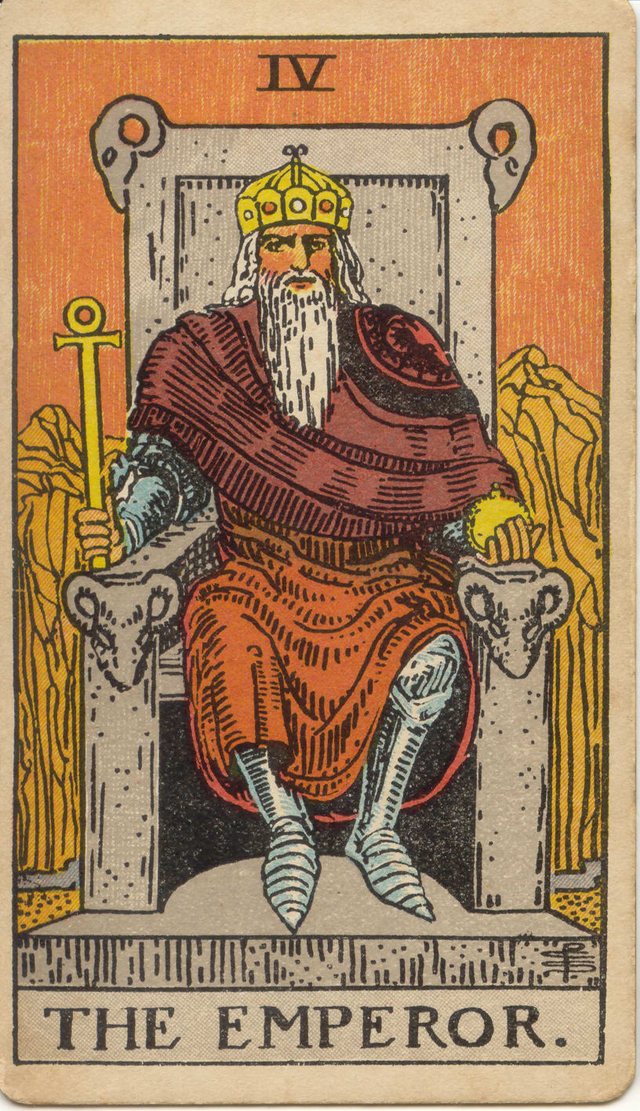
A white-bearded king sits square to the viewer on a massive grey stone throne carved with rams' heads. Under his red robe and cape he wears armour, visible at his arms and on his legs. In his right hand is a golden sceptre in the shape of an ankh, in his left a golden orb. Behind him, under an orange sky, rise steep and bare mountains.
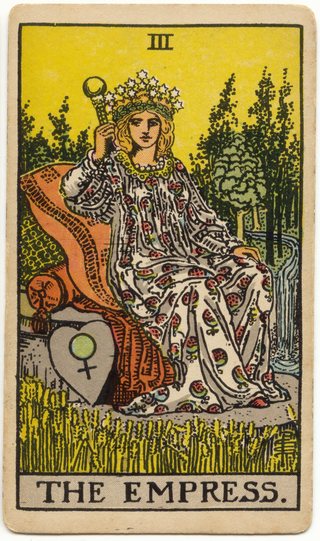
The Emperor is order made visible. Where the Empress lets things grow, he decides where the walls go. The card stands for structure, rules, planning and the kind of authority that takes responsibility: the parent who sets boundaries, the founder who builds a system, the part of you that keeps promises and turns up on time. In a reading it often calls for discipline, a clear plan, or a willingness to lead.
His armour is worth noticing. This is a ruler who has fought for his position and is still ready to defend it, and the land around him is bare rock rather than garden. Structure protects, but it can also harden. The Emperor at his best gives security so that others can flourish; at his worst he mistakes control for care. Much of the card's meaning depends on which side of that line you, or the person it describes, are standing.
The Emperor reversed
Authority gone wrong is the usual reading when the Emperor is reversed. It can describe a controlling boss, partner or parent, rules enforced for their own sake, or your own urge to manage everything because uncertainty feels unbearable. Stubbornness and rigid thinking belong here too.
The reversal can also show the opposite problem: too little structure. Plans with no follow-through, disorder at home or work, a reluctance to take responsibility. Waite's list includes immaturity among the reversed meanings, and that captures it well: the throne is empty, or occupied by someone not yet ready for it. Either way, the card asks who is really responsible here.
In love and relationships
In love the Emperor brings stability and commitment: someone who shows care through reliability, keeping their word and making practical plans for a shared life. It can describe a protective partner, or a relationship that needs clearer agreements about time, roles or responsibilities. The risk is that protection becomes control, or that one person makes every decision. Reversed, the card can point to a power imbalance, jealousy dressed up as concern, or a partner who cannot be relied on at all.
In work and purpose
At work the Emperor is management, systems and accountability. It suits leaders, administrators, founders putting structure into something that grew haphazardly, and anyone facing a decision that needs a firm hand. It may point to an authority figure whose backing matters. It asks whether your plans have a framework and a timetable. Reversed, it can warn of micromanagement, an overbearing boss, procedures that strangle initiative, or a team drifting for want of clear direction.
As advice
Bring order to the situation. Decide what you are responsible for, set clear limits and keep them, and make a plan that does not depend on everything going well. Lead calmly and carry the weight that is yours, but check that your structures still serve people rather than simply holding them in place.
Yes or no?
Yes The Emperor favours firm decisions and stable foundations, so it reads as yes, provided the plan is sound and well run. How yes-or-no readings work here.
Questions to sit with
- Where would a little more structure give me more freedom, not less?
- Am I protecting something, or trying to control it?
- What responsibility am I avoiding that is mine to take?
Symbolism in the card
The stone throne
He sits on a huge, plain grey throne cut from stone, its back square and heavy. Stone means permanence and law: what is built to last and is hard to move. Waite notes that he is sometimes shown seated on a cubic stone instead.
The rams' heads
Four rams' heads are carved on the throne, two at the top corners and two on the arms. The ram is the animal of Aries, the sign that opens the zodiac in spring, associated with initiative and drive. The Golden Dawn assigned Aries to this card.
The ankh sceptre
His right hand holds a golden sceptre shaped like an ankh, the Egyptian sign of life, which Waite calls 'a form of the Crux ansata'. It suggests that his authority is meant to serve life, not merely to command it.
The golden orb
A golden orb rests in his left hand. A royal emblem since the Middle Ages, it stands for dominion over the world: the Emperor holds his territory, quite literally, in the palm of his hand.
The armour
Steel armour shows at his forearms and covers his legs and feet beneath the red robe. He rules from a throne but has not taken it off: readiness to defend what he has built, and perhaps a reluctance to be vulnerable.
The crown, robe and beard
A gold crown set with jewels, a deep red robe and a darker cape mark him as sovereign. Red is energy and will. His long white beard gives him age and experience: this is authority earned over time, not inherited yesterday.
The mountains and orange sky
Behind the throne rise steep, barren mountains under an orange sky. Nothing grows here, in contrast to the Empress's green garden. It is a landscape of hard achievement and a fiery, ambitious temperament.
“He is a crowned monarch—commanding, stately, seated on a throne, the arms of which are fronted by rams' heads. He is executive and realization, the power of this world, here clothed with the highest of its natural attributes.”
Numbers, elements and astrology
Number 4: Four
Four is the square: stability, structure and rest, with the risk of standing still. Fours in tarot often show something held in place.
Fire
Fire is will, energy, desire and creativity: the drive that starts things. The Golden Dawn tied The Emperor to Aries, a sign of Fire.
These are the traditional attributions of the Hermetic Order of the Golden Dawn (1888), which Waite and Smith followed: each trump is matched to a Hebrew letter and to an element, planet or zodiac sign. They are a symbolic system, not astronomy. How we checked them.
A little history
The Emperor is among the earliest tarot trumps and appears in the fifteenth-century Italian hand-painted decks. In the Tarot de Marseille he is L'Empereur, usually drawn in profile with his legs crossed, holding a sceptre, with a shield bearing an eagle beside him. The emblems recall the Holy Roman Emperor. The Golden Dawn attributed the card to Aries, and Smith made that visible: her Emperor faces the viewer directly from a stone throne carved with rams' heads, holds a sceptre topped with an ankh, and wears armour under his robes.