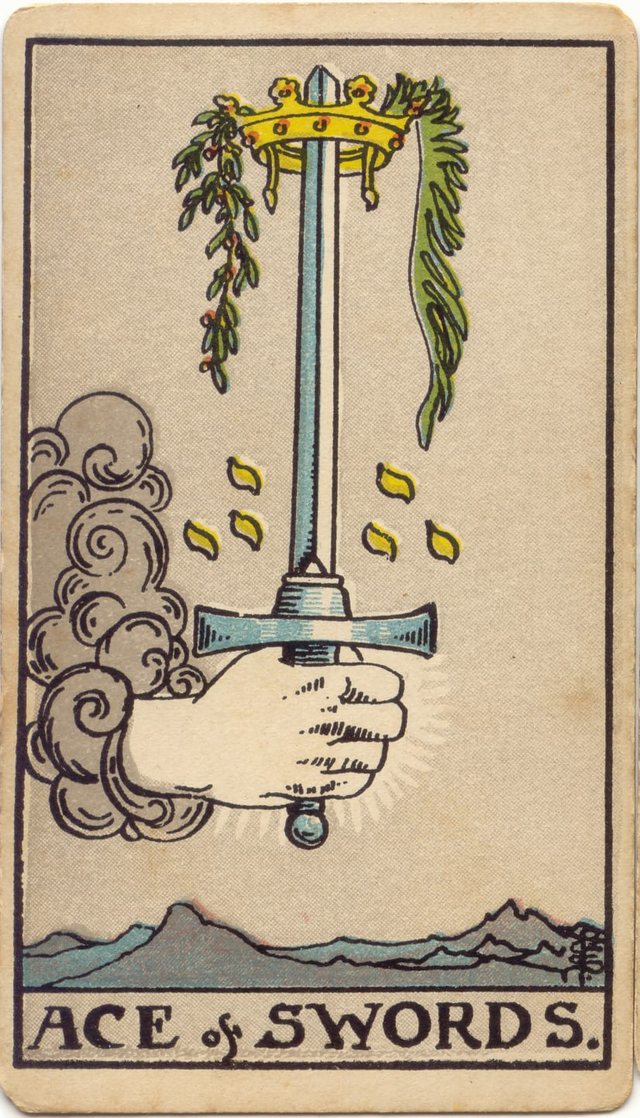
Ace of Swords
Upright clarity · a decisive idea · truth spoken · mental breakthrough · fresh resolve
Reversed muddled thinking · a sharp tongue · force without wisdom · a blocked insight
- Arcana
- Minor · ace
- Number
- Ace
- Element
- 🜁 Air
- Golden Dawn title
- Root of the Powers of Air
- Yes or no
- Yes
Ace of Swords upright
A white hand reaches out of a grey cloud on the left and grips a long, double-edged sword held straight up. A soft halo of short lines surrounds the fist. At the tip, the blade passes through a gold crown hung with two green sprays, a fruiting olive branch on one side and a palm frond on the other, while six yellow drops fall through the empty air. Far below lies a low range of grey-blue mountains. Nothing else is in the picture: no figure, no path, just the offer.
Every ace is a seed, and the seed of Swords is a thought sharp enough to act on. The card turns up when something has come into focus: a problem you have circled for weeks suddenly has a name, a decision that felt impossible becomes obvious, or someone finally says the true thing in the room. Air, the element of the suit, is the medium of words and ideas, and this ace is air at its cleanest.
Clarity is not the same as comfort, though. A sword cuts both ways, and Waite noted that the card carries great force "in love as well as in hatred". Seeing a situation accurately may mean admitting something you would prefer not to know, or ending a story you have been telling yourself. The card does not say what to do with the insight. It hands you the blade and leaves the question of how to use it, honestly and with some care for the people near you, in your own grip.
Ace of Swords reversed
Reversed, the ace usually describes clarity that has not quite arrived or has gone wrong. Thoughts loop instead of landing; you may have plenty of information and no conclusion, or a conclusion you reached too fast. Sometimes the reversal points to words used as weapons: a remark that was true but cruel, a debate won at the cost of the relationship.
Some readers who do not use reversals simply let a difficult neighbouring card colour the ace instead. Those who do often read it as a prompt to slow down, check your reasoning and separate what you know from what you fear before you swing.
In love and relationships
In love, the Ace of Swords favours honesty over mood. It fits the conversation that finally clears the air: saying what you actually want, naming a pattern, or asking the question you have been too polite to ask. It can describe being drawn to someone for their mind before anything else. The risk is turning a relationship into a courtroom, keeping score with sharp observations. Reversed, it may point to arguments that go round in circles, or to a truth that is being withheld because the timing never feels right.
In work and purpose
At work this ace suits the start of anything that runs on thinking: a proposal, a piece of research, a negotiation, a new system that replaces a messy one. It is the moment the brief becomes clear or the bottleneck is finally identified. It also favours plain communication, such as an email that says exactly what is needed. Reversed, it can describe a meeting full of opinions and no decision, or a good idea that is being argued down before it has been tested.
As advice
Say the clear thing, and say it cleanly. You already understand more than you are admitting. Write it down, test it against the facts, and then act on it without dressing it up. Be exact rather than harsh: the point of a sharp blade is that it does not need force.
Yes or no?
Yes The ace brings a clean, decisive answer, so it reads as a yes when the question has been thought through honestly. How yes-or-no readings work here.
Questions to sit with
- What do I already know about this situation that I have not yet said plainly?
- Where am I using cleverness to avoid a simple decision?
- How can I tell the truth here without using it as a weapon?
Symbolism in the card
The upright sword
A plain steel blade, double-edged and perfectly vertical, with a short crossguard and a round pommel. The sword is the emblem of the whole suit: discrimination, the ability to separate one thing from another, and the power of words and decisions.
The hand from the cloud
As on all four aces, a hand appears from a cloud, here on the left, with faint rays around the grip. The gift seems to come from outside ordinary effort: the insight that arrives rather than one that is worked out step by step.
The crown on the point
A gold crown set with red stones rings the very tip of the blade. Readers take it as mastery or victory won by the mind, and Waite hinted that it might signify something higher than worldly success, without saying what.
The olive and the palm
Two sprays hang from the crown: on the left a branch with small leaves and red berries, usually read as olive, on the right a long palm frond. Olive suggests peace and palm victory, so the sword's power is paired with both outcomes.
The six yellow drops
Small yellow flames shaped like the Hebrew letter yod drift downward on either side of the blade. The same shape falls on the Tower and the Moon, and on this card it is often read as grace or spirit descending with the gift.
The mountains below
A thin band of grey and blue peaks runs along the bottom of the card. Mountains often stand for the heights of thought or for difficulties ahead; here they are distant, as if the sword is seen from above the climb.
“It is a card of great force, in love as well as in hatred. The crown may carry a much higher significance than comes usually within the sphere of fortune-telling.”
Numbers, elements and astrology
One
One is the single point, the first stroke: initiative, will and the seed of something. Aces and the Magician share it.
Air: the suit of Swords
Air is thought, speech, truth and conflict: the mind and its sharp edges.
By Golden Dawn tradition the Aces are the roots of their elements and stand outside the zodiac. They are a symbolic system, not astronomy. How we checked them.
A little history
Swords descend from the Italian suit of spade, which became épées in the Tarot de Marseille. Marseille swords are usually drawn as curved blades, but the ace shows a single upright sword held by a hand from a cloud, its point passing through a crown hung with sprays of foliage, so Smith's design follows the older pattern closely. The Golden Dawn called the card the Root of the Powers of Air, which fixed the suit's link with air and the intellect in English occult tarot.