Queen of Swords
Upright clear perception · honesty · independence · experience · boundaries
Reversed coldness · bitterness · harsh judgement · cruelty · emotional distance
- Arcana
- Minor · court card
- Number
- Queen
- Element
- 🜁 Air
- Sub-element
- Water of Air
- Yes or no
- Yes
Queen of Swords upright
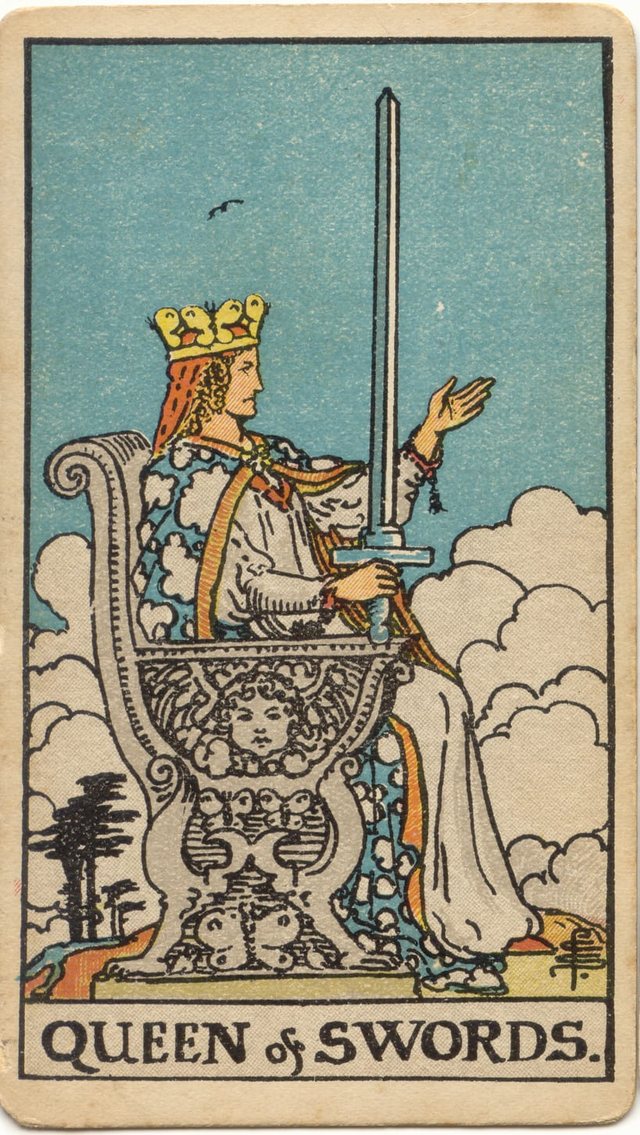
The queen sits in profile on a high grey stone throne, facing to the right. In her right hand she holds a sword straight up, its hilt resting on the arm of the chair; her left hand is raised and open, reaching out. She wears a gold crown and a grey gown under a blue cloak patterned with white clouds. Carved on the side of her throne is a winged child's head. Clouds gather below her, dark trees stand at the lower left, and a single bird flies high in the clear blue sky.
Waite described her face as "severe but chastened", suggesting "familiarity with sorrow", and that is the key to her. The Queen of Swords knows things because she has lived through them. She sees clearly, speaks honestly and is not easily fooled, having learned what flattery, self-deception and false comfort cost. As a person, she may be someone who gives straight advice, keeps her own counsel, or has rebuilt her life after loss. She may be you.
As an approach, the card favours honesty, boundaries and independent judgement. The open hand matters as much as the sword. She is not cold for the sake of it, and her clarity can be a form of kindness, offered to people ready to hear the truth.
Queen of Swords reversed
Reversed, the queen's clarity can harden. Honesty becomes harshness, boundaries become walls, and experience curdles into bitterness or suspicion. Waite's reversed meanings were blunt: "malice, bigotry, artifice, prudery".
The reversal can also describe someone cutting themselves off to avoid being hurt again, or judging others by a standard they would never apply to themselves. Some readers see it as a sign that a painful past is shaping present decisions too strongly. As a person, the reversed queen may be someone whose wit has become cutting, or whose independence has left them lonely. The question is what the sword is now protecting.
In love and relationships
In love, the Queen of Swords values truth over romance and will not settle for games. She can describe someone independent, discerning and slow to trust, or the moment you decide what you will no longer accept. A relationship with her energy is honest and grown-up, though it may feel cool at first. Reversed, it suggests emotional distance, sharp criticism, or an old hurt keeping someone from letting anyone close.
In work and purpose
At work the card fits clear-sighted leadership, editing, analysis, mentoring, negotiation and any role that needs sound judgement under pressure. She is the colleague who reads the contract properly and says what she thinks in the meeting. The card can also favour working independently. Reversed, it can describe a harsh critic, a cold workplace, or someone using intellect to keep others at a distance.
As advice
Look at the situation without illusions, and say what you see, calmly and without cruelty. Draw your boundaries where they need to be. You have learned more from difficult experiences than you realise; use that knowledge, and keep one hand open to others.
Yes or no?
Yes The queen's clear-eyed judgement supports a yes, as long as the decision is based on the facts rather than hope. How yes-or-no readings work here.
Questions to sit with
- What do I know from experience that I keep second-guessing?
- Where do I need clearer boundaries, and where have mine become walls?
- How can I be honest here and still kind?
Symbolism in the card
The upright sword
She holds the sword perfectly straight, its hilt resting on the arm of her throne. Upright and steady, it reads as clear judgement, the ability to cut through confusion and pretence without hesitation.
The raised open hand
Her left hand is lifted, palm up and open, as if to greet, receive or invite. Waite noted it without explaining it. Many readers take it as openness to truth and to others, balancing the severity of the blade.
The butterfly crown
Her gold crown appears to be made of butterfly shapes, though the scan is not perfectly clear. Butterflies are creatures of air, the suit's element, and long-standing images of the soul and of transformation.
The carved throne
Her high grey throne carries a winged child's head on its side and further carving below. The winged head is often read as a cherub or a sylph, a spirit of air, softening the hard grey stone.
The cloud-patterned cloak
Over a grey gown she wears a blue cloak patterned with white clouds. Clouds belong to air and thought, so she wears her element like a garment.
The single bird
One small bird flies high in the open sky above her. A lone bird suggests both freedom and solitude, and many readers link it with independent, far-seeing thought.
The clouds and trees below
Banks of clouds gather around the lower part of the card, with dark trees at the far left. She sits above the clouds, calm and upright, while weather moves beneath her.
“her countenance is severe but chastened; it suggests familiarity with sorrow. It does not represent mercy, and, her sword notwithstanding, she is scarcely a symbol of power.”
Numbers, elements and astrology
Queen
Queens hold the suit inwardly: mastery that is receptive, nurturing and self-possessed.
Air: the suit of Swords
Air is thought, speech, truth and conflict: the mind and its sharp edges.
In the Golden Dawn system each court card is an element within its suit's element. Pages and Queens are agreed; Knights and Kings are Fire or Air depending on whether you follow the Golden Dawn's names or later practice. They are a symbolic system, not astronomy. How we checked them.
A little history
The Queen of Swords is a seated sword-bearing queen in the Tarot de Marseille. In the Golden Dawn system the Queens stand for the watery part of their element, so this card is the water of air. Waite's traditional meanings, including "widowhood" and "mourning", give her a sorrowful cast that Smith reflected in her stern profile, though modern readers usually stress her independence and clear perception rather than loss.