Page of Swords
Upright curiosity · vigilance · new ideas · honest questions · eagerness to learn
Reversed gossip · all talk · defensiveness · scattered thinking · prying
- Arcana
- Minor · court card
- Number
- Page
- Element
- 🜁 Air
- Sub-element
- Earth of Air
- Yes or no
- Maybe
Page of Swords upright
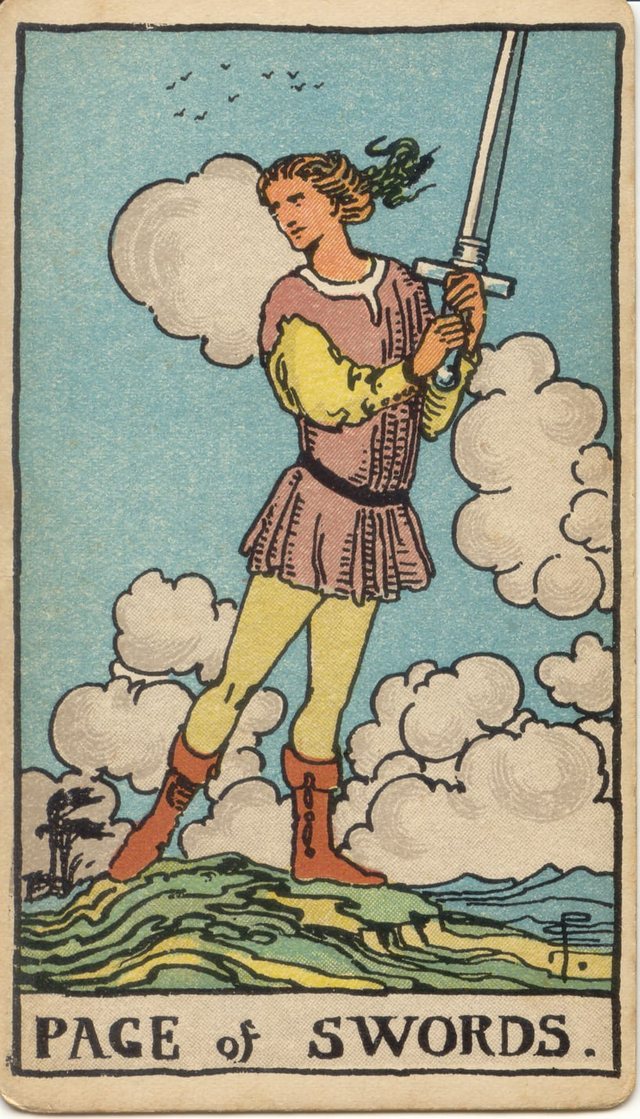
A young man stands on a rough green hilltop, holding a sword upright in both hands as if ready to strike or parry. His body faces one way while his head turns sharply over his shoulder to look the other. He wears a rose-pink tunic with yellow sleeves, yellow hose and red boots, and his hair streams in the wind. Around him, white clouds pile up against a clear blue sky, a flock of birds wheels overhead, a small tree bends to the wind on the left, and on the right blue hills and water lie far below.
The Page of Swords is the suit's student: a mind that has just discovered its own sharpness. It shows curiosity, a hunger for information, a talent for spotting what does not add up and asking the awkward question. Waite stressed vigilance, describing him "looking this way and that, as if an expected enemy might appear at any moment". As a person, this might be a young or new colleague, a sharp-tongued friend, a researcher, or the part of you that cannot leave a puzzle alone.
As an approach to a situation, the card suggests gathering facts, staying alert and speaking honestly. Its weakness is inexperience. The page holds the sword high but has not yet learned when not to use it, and enthusiasm for the truth can tip into argument, nosiness or suspicion.
Page of Swords reversed
Reversed, the page's quickness turns less useful. Talk outruns action, criticism comes before understanding, or curiosity becomes gossip and prying, close to Waite's extra meaning of "an indiscreet person" looking into others' secrets.
It can also describe defensiveness: being so ready for attack that every comment sounds like one. Some readers see scattered thinking, too many ideas and no follow-through. Ask whether the sword is being used to learn or to wound. As a person, the reversed page might be someone who passes on secrets, picks fights for sport, or criticises from the sidelines without ever stepping in to help.
In love and relationships
In love, the Page of Swords suggests a relationship that runs on conversation and wit: banter, long messages, a meeting of minds. It can also show someone cautious, testing a new partner with questions before trusting them, or a habit of analysing feelings instead of having them. Honest communication is the strength; checking up on someone is the trap. Reversed, it may point to arguments, mixed messages or gossip that unsettles things.
In work and purpose
At work the card fits the early stages of learning something demanding, research and investigation, auditing, journalism or any role that rewards attention to detail and quick thinking. It can describe a new colleague full of questions. It favours checking your sources and staying alert to changes. Reversed, it can show careless talk, criticism without solutions, or a project that produces plenty of discussion and little progress.
As advice
Stay curious and keep your eyes open. Ask the question others are avoiding, check the facts, and say what you see, but listen as hard as you talk. Sharpness is a gift; use it to understand the situation, not just to win the point.
Yes or no?
Maybe The page asks for more information before deciding, so the answer is not yet clear. How yes-or-no readings work here.
Questions to sit with
- What question am I most curious about right now, and have I actually asked it?
- Am I being watchful, or simply suspicious?
- How do my words land with the people who hear them?
Symbolism in the card
The raised sword
He holds the sword upright in both hands, slightly angled, as if ready to strike or block at any moment. It is a young mind's newly found ability to cut through things, held with energy but not yet with mastery.
The turned head
His body moves one way while his face looks back over his shoulder. Waite read this as alertness, watching for an expected enemy. It suggests vigilance, curiosity, and a mind that cannot settle on one direction.
The billowing clouds
Large white clouds gather around him against a blue sky. Waite described them as 'collocated wildly'. They belong to air, the suit's element, and to a head full of rapidly changing ideas.
The flock of birds
A loose flock of small dark birds flies high in the upper part of the card. Birds are messengers and creatures of air, a fitting image for quick thoughts, news and gossip passing overhead.
The wind-bent tree
On the left a small dark tree leans and streams in the wind, matching the page's blowing hair. It makes the invisible air visible, and the sense of restlessness that comes with it.
The rough high ground
He stands on an uneven green rise above a distant landscape of blue hills and water. High ground gives a good view and an advantage, but the footing here is rough, much like the page's position: alert, but not yet secure.
“He is alert and lithe, looking this way and that, as if an expected enemy might appear at any moment.”
Numbers, elements and astrology
Page
Pages are students and messengers: curiosity, news, the beginner's first approach to the suit.
Air: the suit of Swords
Air is thought, speech, truth and conflict: the mind and its sharp edges.
In the Golden Dawn system each court card is an element within its suit's element. Pages and Queens are agreed; Knights and Kings are Fire or Air depending on whether you follow the Golden Dawn's names or later practice. They are a symbolic system, not astronomy. How we checked them.
A little history
The page descends from the Valet of the Tarot de Marseille, the lowest court card, usually a standing youth. The Golden Dawn reorganised the courts as King (or Knight), Queen, Prince and Princess, which made this card a Princess. Waite kept the older names, Page, Knight, Queen and King, which is the form most modern English decks follow. Smith's windy hilltop and flock of birds are her own additions.