Major Arcana · III
The Empress
Upright abundance · nurture · creativity · comfort · growth
Reversed creative block · smothering care · self-neglect · dependence
- Arcana
- Major
- Number
- III
- Astrology
- ♀ Venus
- Hebrew letter
- Daleth ד
- Yes or no
- Yes
The Empress upright
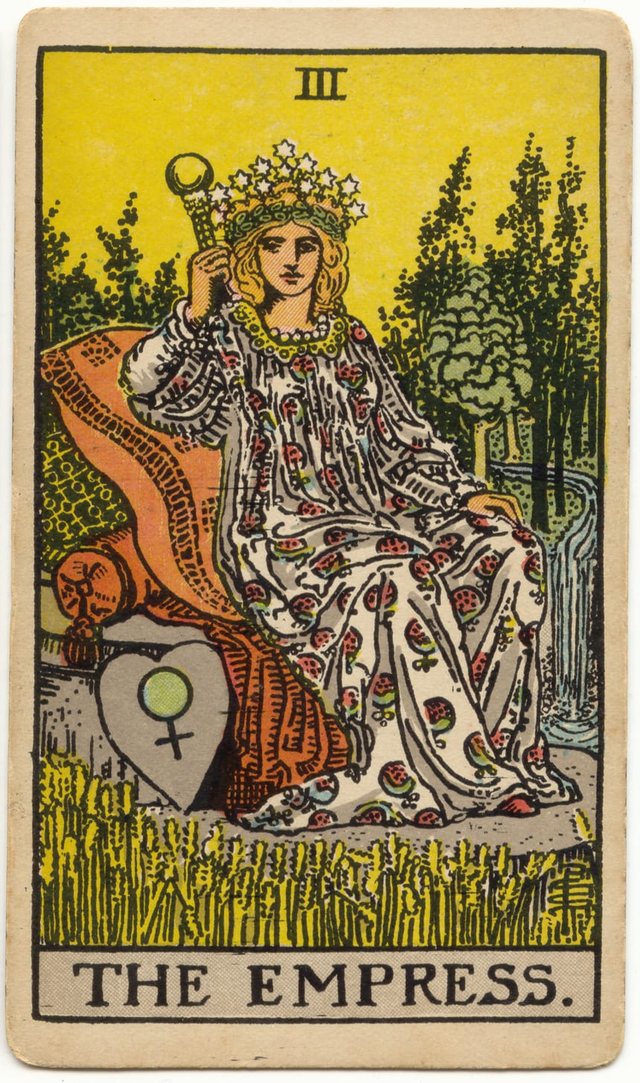
A fair-haired woman reclines on a cushioned seat in the open air, wearing a loose white gown patterned with red fruit and a crown of small white stars. She holds up a sceptre topped with a globe. A heart-shaped shield bearing the sign of Venus leans beside her. Ripe grain grows in front of her, tall trees rise behind, and on the right a stream falls over rocks, all under a yellow sky.
The Empress is the most relaxed figure in the Major Arcana. She does not stand, strive or guard anything; she is at home in a world that is growing around her. The card stands for fertility in the widest sense: the conditions in which things flourish, whether they are gardens, friendships, art, a household or a business. It values the senses, good food, beauty and rest, not as indulgences but as part of what keeps a life fruitful.
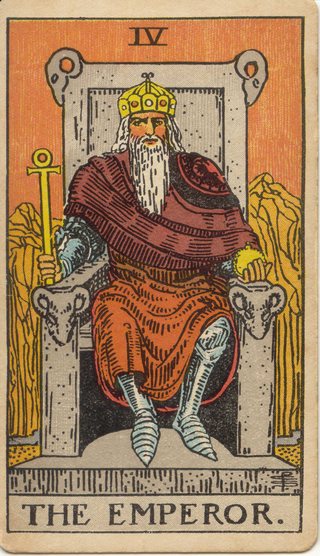
Where the Emperor builds by structure and rule, the Empress grows things by care and time. Her abundance is not luck. Grain ripens because it was sown and tended, and the card often turns up when something you have nurtured is ready to bear fruit, or when you need to give yourself the care you give others. It invites generosity, creativity and a little more pleasure in ordinary days.
The Empress reversed
Reversed, the Empress can show care that has slipped out of balance. Sometimes there is too much of it: smothering, over-giving, making yourself indispensable to people who would do better finding their own feet. Sometimes there is too little: creative work stalled, a home or body neglected, a sense that nothing is growing.
Many readers take the reversal as a sign to turn the nurture inward. If you are worn out from tending everything else, your own needs belong in the garden too. It can also point to a dependence, on a person, a comfort or a role, that has stopped being nourishing.
In love and relationships
In love the Empress is warmth, affection and physical closeness: a relationship that feels generous and easy, in which both people are looked after. It can point to deepening commitment, making a home together, or simply enjoying each other more. For someone single, it encourages contentment in your own life first, since attraction tends to follow it. Reversed, it can describe one partner mothering the other, a relationship that has become more duty than pleasure, or insecurity that makes you cling.
In work and purpose
At work the Empress favours creative projects, design, hospitality, teaching, the caring professions and anything that grows steadily rather than by force. It suggests a period when effort put in earlier starts to show, and a style of leadership that develops people instead of commanding them. It can also ask whether your workplace lets you flourish. Reversed, it may point to creative block, exhaustion from looking after everyone, or a project stalling because nobody is tending it.
As advice
Tend what matters to you and give it time. Feed your creativity, your relationships and your body with the patience a gardener gives a field. Make room for pleasure and beauty, and count yourself among the things you look after.
Yes or no?
Yes The Empress is a card of growth and good conditions, so it reads as a warm yes, especially for creative or personal questions. How yes-or-no readings work here.
Questions to sit with
- What have I planted that now needs patient tending?
- Where do I give care freely to others but withhold it from myself?
- What simple pleasure have I been treating as an indulgence rather than a need?
Symbolism in the card
The crown of stars
Her crown is a cluster of small white stars set on a band of green leaves. Waite counts twelve, and readers link them to the months of the year or the signs of the zodiac: she presides over the whole turning year.
The Venus shield
A grey heart-shaped shield rests against her seat, marked with the symbol of Venus. It names her as a figure of love and beauty, and makes a heart, rather than a coat of arms, her emblem of authority.
Venus symbol in tarotHeart in tarotShields and coats of arms in tarot
The sceptre and globe
She holds a short golden sceptre topped with a round globe. Waite calls it 'the globe of this world': her rule is over the earth and living things, not over doctrine or armies.
The patterned gown
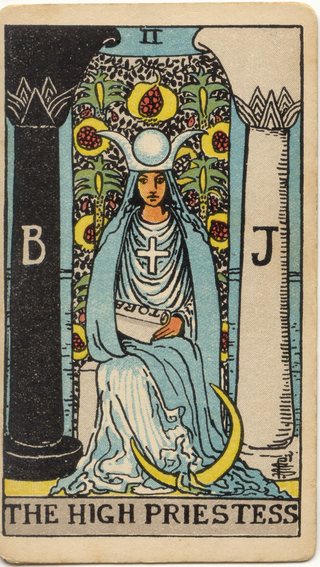
Her loose white gown is scattered with red fruit, usually read as pomegranates. The fruit's many seeds make it an old emblem of fertility, and it links her with the High Priestess, whose veil carries the same fruit.
The ripening grain
Tall yellow grain fills the foreground; Waite calls it 'a field of corn', meaning wheat or similar cereal. It is harvest, nourishment and the reward of tending: abundance that comes out of the soil.
The trees and waterfall
Dark, tall trees stand behind her, and on the right a stream pours down over rocks. Water feeding a green landscape suggests feeling and life flowing freely, the source that keeps her garden alive.
The cushioned seat
She lounges on plump red-orange cushions over a stone seat in the open air. Unlike the stone thrones of the Emperor and the Hierophant, hers is soft and outdoors: comfort and pleasure are part of her power.
“A field of corn is ripening in front of her, and beyond there is a fall of water. The sceptre which she bears is surmounted by the globe of this world.”
Numbers, elements and astrology
Number 3: Three
Three is the first number that makes a shape: two things meet and produce a third. It is the number of growth, collaboration and first results.
These are the traditional attributions of the Hermetic Order of the Golden Dawn (1888), which Waite and Smith followed: each trump is matched to a Hebrew letter and to an element, planet or zodiac sign. They are a symbolic system, not astronomy. How we checked them.
A little history
The Empress is one of the original trumps of the fifteenth-century Italian decks. In the Visconti-Sforza cards and in the Tarot de Marseille, where she is L'Impératrice, she sits upright and formal with a sceptre and a shield bearing an eagle, the emblem of imperial power. The Rider-Waite-Smith Empress is a much softer figure. Smith moved her outdoors into a field of grain beside trees and running water, replaced the eagle with a heart-shaped shield marked with Venus, and gave her the crown of twelve stars. Waite accepts the old description of her as the woman clothed with the sun, the figure in the Book of Revelation who wears such a crown.