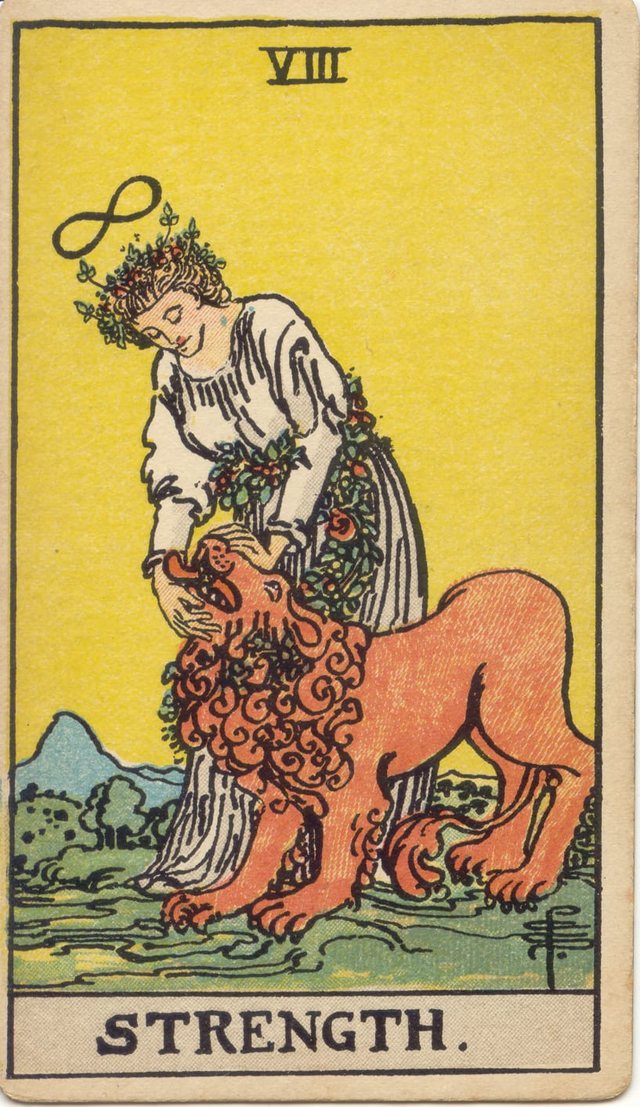
Major Arcana · VIII
Strength
Upright inner strength · courage · compassion · patience · gentle control
Reversed self-doubt · raw emotion · harshness · loss of nerve
- Arcana
- Major
- Number
- VIII
- Element
- 🜂 Fire
- Astrology
- ♌ Leo
- Hebrew letter
- Teth ט
- Yes or no
- Yes
Strength upright
A woman in a white gown bends over a red lion, her hands at its open jaws. Flowers are twined in her hair and a garland of roses runs from her waist to the lion's neck. Above her head floats the same figure of eight that hangs over the Magician. The lion lifts its head to her with its tail curled low. A blue mountain rises on the left, and the sky is a clear, even yellow.
The card is called Strength, yet nothing in it is forced. She is not fighting the lion; she seems to be calming it, and the lion looks content to be handled. That is the core of the card: courage that works through patience, the capacity to hold powerful feelings, your own or someone else's, without crushing them or being run by them. It is the strength of a person who can stay kind under pressure.
The lion is easy to read as anger, fear, desire or appetite, the instinctive self that can be frightening. The card does not ask you to get rid of it. The lion keeps its size and its teeth. Strength describes a relationship with your own wildness built on trust rather than suppression, and it often appears when gentle persistence will achieve more than confrontation, whether with a difficult person, a habit or a fear.
Strength reversed
Reversed, Strength can show the lion getting the upper hand: temper flaring, anxiety taking over, impulses running the day. It can also describe self-doubt, the feeling that you lack the resources to cope when in fact you have more than you think.
Another reading puts force where gentleness should be: trying to control yourself or others through harshness, which only makes the lion wilder. Waite's list of reversed meanings includes the abuse of power. Some readers simply see a period of depletion, when you need rest before you can be steady again. Gentleness, in that case, starts with how you treat yourself.
In love and relationships
In love Strength describes patience, warmth and emotional steadiness: being able to stay kind through a hard conversation, or supporting a partner in a difficult time without losing yourself. It can point to passion handled with care, desire that is strong but trusting. For someone single, it suggests a confidence that does not need to perform. Reversed, it may show jealousy, temper or insecurity straining things, or one partner who is always the one doing the soothing.
In work and purpose
At work Strength favours quiet confidence over aggression: handling a difficult client with grace, steadying a tense team without raising your voice, or persisting with a demanding project one day at a time. It suits teaching, care work, negotiation and any role that involves managing strong personalities. Reversed, it can warn of frustration boiling over, exhaustion from holding everything together, or a crisis of confidence just when your experience is most needed.
As advice
Meet what is wild in the situation with patience rather than force. Stay calm, stay kind and keep your hand steady. Your feelings are not enemies to defeat but energy to work with, and other people often respond to gentleness more readily than to pressure.
Yes or no?
Yes Strength reads as yes: the situation can be handled through patience and steady courage. How yes-or-no readings work here.
Questions to sit with
- What strong feeling am I trying to crush instead of understand?
- Where would gentleness achieve more than force?
- When have I been stronger than I expected, and what made that possible?
Symbolism in the card
The lion
A large red-orange lion with a thick curling mane lifts its head into her hands, tongue showing. It is the classic image of raw instinct, passion and courage, and here it is neither wounded nor bound in iron.
Her hands at the jaws
Her hands rest at the lion's open mouth. Waite says she is closing its jaws; others see her opening them. Either way she touches the most dangerous part of the animal with no weapon and no sign of fear.
The figure of eight
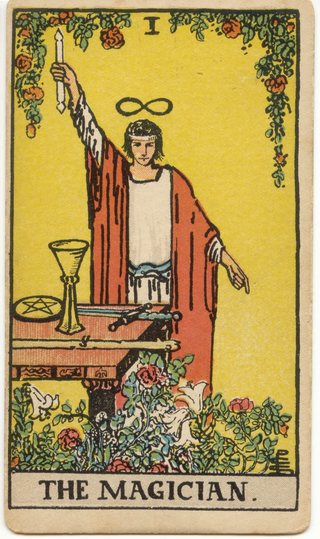
The sign of infinity hovers over her head, as it does over the Magician's. There it stands for energy put to use; here it suggests a patience that does not run out.
The chain of flowers
A garland of roses and leaves circles her waist and loops round the lion. Waite calls it a chain of flowers, 'the sweet yoke and the light burden', gentle restraint freely accepted in place of a chain of iron.
The flowers in her hair
Leaves and small flowers are woven through her hair. Like the garland, they tie her to growth and the natural world: her strength is a living, cultivated kind, not the hardness of armour.
The white gown
She wears a plain white gown. White is innocence and clear intention, and Waite connects the card with 'innocentia inviolata': goodness that stays untouched by the beast it handles.
The mountain and yellow sky
A blue peak rises in the distance on the left, above green fields and trees, and the whole scene is lit by a flat yellow sky. The mountain suggests a long aim; the yellow gives the card its warmth and openness.
“There is one aspect in which the lion signifies the passions, and she who is called Strength is the higher nature in its liberation.”
Numbers, elements and astrology
Number 8: Eight
Eight is movement and mastery: effort repeated until it becomes skill, and the momentum to leave what no longer serves.
Fire
Fire is will, energy, desire and creativity: the drive that starts things. The Golden Dawn tied Strength to Leo, a sign of Fire.
These are the traditional attributions of the Hermetic Order of the Golden Dawn (1888), which Waite and Smith followed: each trump is matched to a Hebrew letter and to an element, planet or zodiac sign. They are a symbolic system, not astronomy. How we checked them.
A little history
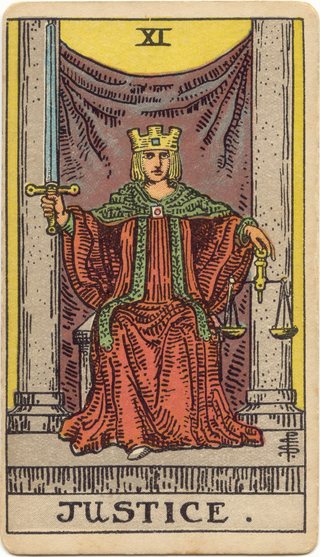
Strength began as Fortitude, one of the cardinal virtues, and stands in the old sequence alongside Justice and Temperance. Early Italian images vary: the fifteenth-century Visconti-Sforza card shows a man raising a club against a lion, a figure often identified as Hercules. The Tarot de Marseille's La Force shows a woman in a wide-brimmed hat holding a lion's jaws, numbered XI. The Golden Dawn linked the card to Leo and moved it to VIII to fit its astrological scheme, and Waite followed, swapping it with Justice. Smith added the infinity sign and the chain of flowers.