Knight of Cups
Upright romance · an invitation · following the heart · idealism · charm
Reversed moodiness · unrealistic promises · jealousy · disappointment · a proposal that falls through
- Arcana
- Minor · court card
- Number
- Knight
- Element
- 🜄 Water
- Sub-element
- Fire or Air of Water (varies)
- Yes or no
- Yes
Knight of Cups upright
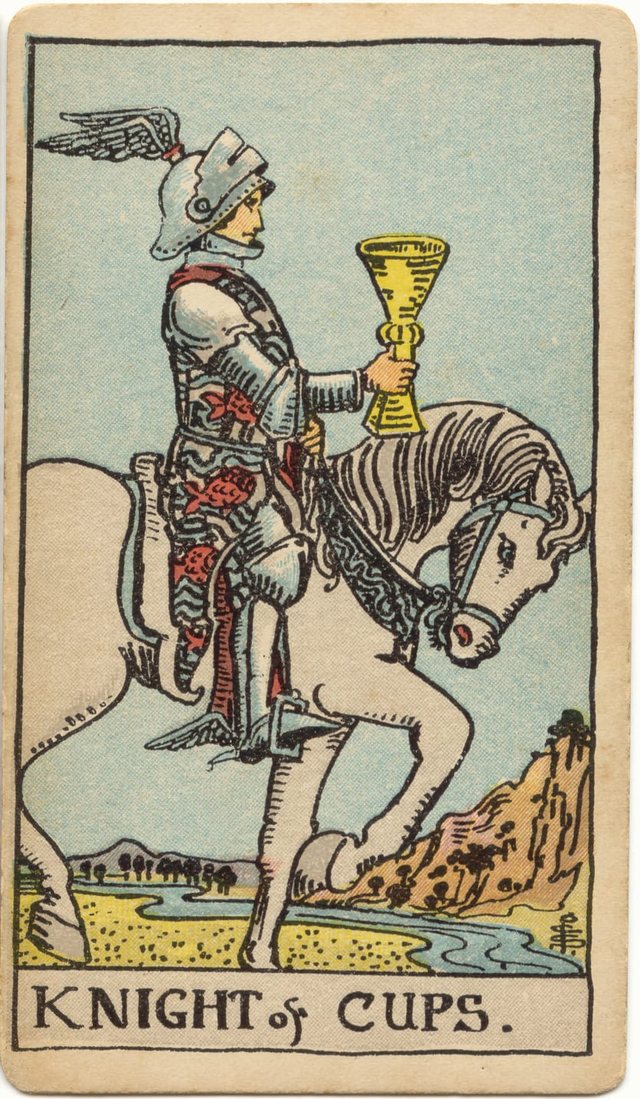
A knight in silver armour rides a pale grey horse at a slow, deliberate walk, holding a gold cup out before him as if carrying it carefully to someone. His helmet has small wings on it, and there are wings at his heels too. Over the armour he wears a tunic patterned with red fish and blue waves. The horse lowers its head and lifts one foreleg high. They are crossing towards a stream that winds through yellow ground, with a brown rocky slope on the right.
As a person, the Knight of Cups is the romantic of the deck: charming, sincere, creative, led by feeling. He may be a suitor, an artist, a friend who brings warmth, or the part of you that wants to act on what you feel. Waite stresses that he is 'Graceful, but not warlike', and that he too 'is a dreamer'.
As an approach, the card suggests moving towards something because it moves you. It often marks an offer or invitation: a proposal, a creative opportunity, a gesture of reconciliation. Unlike the other knights, he is in no hurry. The risk lies in the same dreaminess that makes him appealing: a knight who rides for an ideal can be slow to notice the ground in front of him.
Knight of Cups reversed
Reversed, the Knight's idealism can turn unreliable. Many readers see charm without follow-through, promises that are not kept, or someone who falls in love with a fantasy and then loses interest when real life begins. Waite's reversed meanings are blunt: 'Trickery, artifice, subtlety, swindling, duplicity, fraud'.
The reversal can also describe moodiness, jealousy or sulking when feelings are not returned, or an invitation that is withdrawn or turns out to be less than it seemed. Some readers simply read it as a romantic impulse arriving at the wrong moment. Either way, it asks for a closer look at whether words and actions match.
In love and relationships
In love the Knight of Cups is the classic suitor: someone who courts, writes, makes gestures and means them. It can describe a declaration of feeling, a romantic invitation or the arrival of someone attentive and charming. In a relationship it can bring romance back. Its caution is that idealised love can wilt under ordinary pressures. Reversed, it may point to someone who promises more than they deliver, or who loves the idea of you more than the reality.
In work and purpose
At work the card suits creative fields, the arts, design and any role that needs charm and emotional intelligence. It can describe a job offer, an invitation to collaborate, or a chance to follow a calling rather than a pay scale. It can also warn against idealism that ignores budgets and deadlines. Reversed, it may suggest a proposal that falls through, or a colleague full of enthusiasm and short on delivery.
As advice
Follow what genuinely moves you, and act on it with grace rather than haste. If you have something to offer, offer it openly. But keep one eye on the ground in front of you: check that your ideals and your plans line up, and that what you promise is something you can carry all the way.
Yes or no?
Yes The Knight comes carrying an offer, so the card reads as yes, though one that asks you to check the offer is as real as it is appealing. How yes-or-no readings work here.
Questions to sit with
- What would I do if I simply followed my heart in this situation?
- Am I in love with this person, project or idea, or with my picture of it?
- What offer am I carrying to someone, and am I ready to deliver it?
Symbolism in the card
The held-out cup
The Knight holds a gold cup steadily out in front of him at chest height, like a gift being brought. It makes him a bearer of feeling or of an offer: his purpose is to deliver something, not to conquer.
The winged helmet and heels
Small grey wings rise from his helmet and from his heels. They recall Hermes, the messenger, and Waite reads them as 'those higher graces of the imagination': a mind that travels faster than the horse.
The fish tunic
Over his armour he wears a tunic printed with red fish swimming among blue waves. It marks him clearly as a knight of water, carrying the suit's emotion and imagination on his body.
The pale horse
His grey-white horse walks slowly with its head bowed and one foreleg raised. Unlike the charging horses of the other knights, it moves calmly, matching the rider's gentle, unhurried temperament.
The armour
He is fully armoured in silver plate, yet carries no weapon in sight. The armour gives him the dignity of a knight while the cup shows that his errand is peaceful.
The stream and rocky slope
A narrow blue stream winds across sandy yellow ground, and a brown rocky slope with small trees rises on the right. Water must be crossed and ground climbed: feeling has to meet the real terrain of life.
“Graceful, but not warlike; riding quietly, wearing a winged helmet, referring to those higher graces of the imagination which sometimes characterize this card.”
Numbers, elements and astrology
Knight
Knights are the suit in motion: action, pursuit and sometimes excess, the energy as a quest.
Water: the suit of Cups
Water is feeling, intuition, relationships and the imagination.
In the Golden Dawn system each court card is an element within its suit's element. Pages and Queens are agreed; Knights and Kings are Fire or Air depending on whether you follow the Golden Dawn's names or later practice. They are a symbolic system, not astronomy. How we checked them.
A little history
The Knight of Cups descends from the Cavalier de Coupe of the Tarot de Marseille, a rider carrying a cup. The Golden Dawn reorganised and retitled the court cards, but Waite kept the familiar King, Queen, Knight and Page of older Italian and French packs. The winged helmet and heels, the tunic of fish and waves and the slow, head-bowed horse belong to the 1909 design and make him unmistakably a figure of water and imagination.