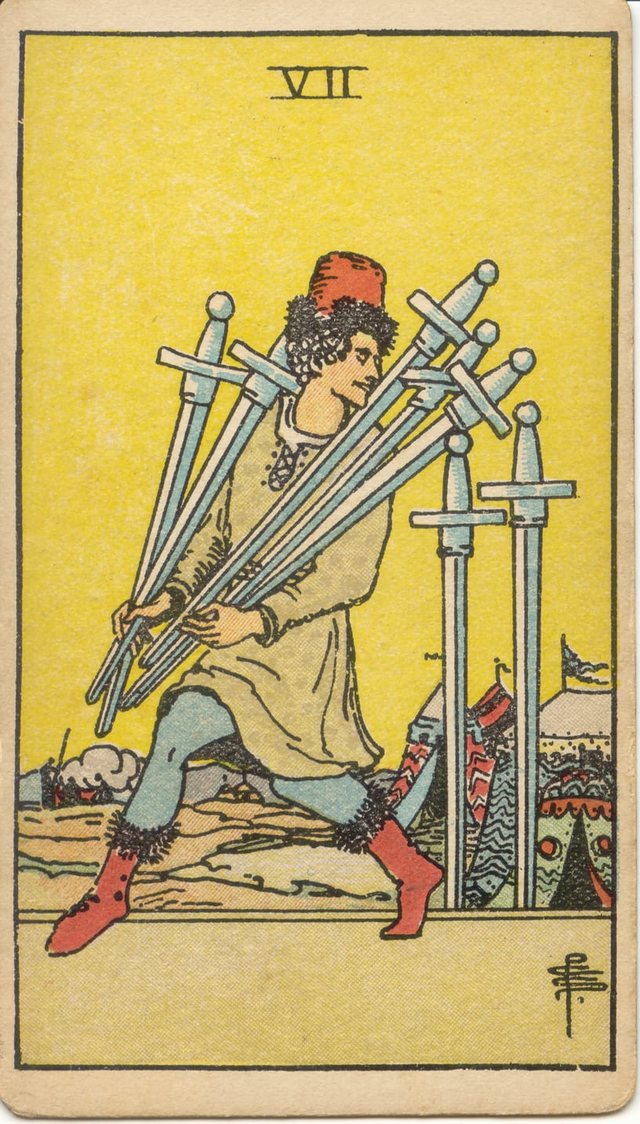
Seven of Swords
Upright strategy · stealth · deception · going it alone · a calculated risk
Reversed coming clean · getting caught · conscience · a plan unravels · taking advice
- Arcana
- Minor · pip card
- Number
- Seven
- Element
- 🜁 Air
- Astrology
- ☽ Moon in ♒ Aquarius
- Golden Dawn title
- Lord of Unstable Effort
- Yes or no
- Maybe
Seven of Swords upright
Against a bright yellow sky, a man in a red cap and soft red boots tiptoes away from a camp. He carries five swords bundled awkwardly in his arms, gripped near the blades, and looks back over his shoulder with a half smile. Two swords remain stuck upright in the ground behind him. To the right stand striped tents with small flags; far off on the left there is a cloud or plume of smoke and what may be a few distant figures.
This is the card of getting away with it, or trying to. It covers a range from clever to crooked: a smart workaround, a discreet exit, a plan kept close to the chest, but also a lie, a theft, or taking credit that belongs to someone else. Waite admitted the meanings were "widely at variance with each other", and the image keeps that ambiguity. We do not know whose swords these are, or whether the camp has wronged him.
When it turns up, the card usually asks about honesty and method. Is there something you are doing quietly because it would not survive being seen? Or is someone around you less straightforward than they appear? It can also be a fair call for strategy: not every situation is improved by a frontal approach. Note, though, that he could not carry all seven.
Seven of Swords reversed
Reversed, the secret tends to come out. A plan may be discovered, or your own conscience may make it impossible to keep going: the reversal is often read as coming clean, returning what was taken, or abandoning a scheme that was never going to work.
Waite's reversed meanings were "good advice, counsel, instruction" alongside "slander, babbling", so some readers take the reversal as the moment to listen to someone else instead of going alone, and others as gossip or exposure. Context decides. A reversal near Justice, for example, will usually lean towards consequences; near the Hierophant, towards counsel.
In love and relationships
In love, the Seven of Swords raises the question of honesty: a partner who is not telling the whole truth, a secret you are keeping, or a relationship that has to stay hidden. It can also describe self-protection, keeping part of yourself back because trust has not yet been earned. It does not prove deceit; it asks you to notice where things do not add up. Reversed, it may point to a confession, or to deciding to be more open.
In work and purpose
At work the card fits a clever tactical move, competitive secrecy, a job search kept quiet, or a colleague taking credit for your ideas. It can mean bending the rules to get a result, and it asks whether the shortcut will hold up later. It also describes working alone when collaboration would serve better. Reversed, it may show a scheme being exposed, or the wisdom of asking for advice before acting.
As advice
Be strategic, but check that you could defend your method if it came to light. If you are sneaking something past others, ask why it needs to be hidden. And if you are trying to carry everything yourself, notice what you are leaving behind.
Yes or no?
Maybe The card shows a partial success gained by uncertain means, so the answer depends on whether the plan is honest. How yes-or-no readings work here.
Questions to sit with
- What am I doing quietly that I would not want others to see?
- Where might I be fooling myself about my own motives?
- Is going it alone actually serving me here?
Symbolism in the card
The man in the red cap
He wears a pale tunic, blue leggings, fur-trimmed red boots and a tall red cap. He moves on tiptoe while looking back towards the camp with a slight smile, the classic posture of someone slipping away unseen.
The five carried swords
He holds five swords bunched together, gripped by the blades rather than the hilts. It is an awkward, risky way to carry them, which suits a plan more clever than safe.
The two swords left behind
Two swords remain upright in the ground at his back. He could not take everything: whatever he has got away with is incomplete, and what he left may give him away.
The camp
On the right are striped and patterned tents with pennants on their poles. Waite says simply 'a camp is close at hand'. It is the community or opponent being left, apparently unaware of what is happening.
The yellow sky
The whole background is bright yellow. In the Smith deck yellow skies often go with daylight clarity and intellect, which gives the scene an oddly open, exposed quality for an act of stealth.
The distant smoke
Far off on the left a grey puff of cloud or smoke rises near what may be a few small figures. It is hard to read clearly, but it hints at activity elsewhere: perhaps others are watching, perhaps the distraction that allows the theft.
“The design is uncertain in its import, because the significations are widely at variance with each other.”
Numbers, elements and astrology
Seven
Seven is the number of testing and reflection: the point mid-way where results are weighed, and imagination, doubt or courage are asked for.
Air: the suit of Swords
Air is thought, speech, truth and conflict: the mind and its sharp edges.
By Golden Dawn tradition each numbered card from two to ten rules ten degrees of the zodiac (a decan): the Seven of Swords is Moon in the third decan of Aquarius. They are a symbolic system, not astronomy. How we checked them.
A little history
The Tarot de Marseille seven of swords is an arrangement of curved blades crossed by a single straight one, with no figures. The Golden Dawn titled it the Lord of Unstable Effort. Smith's thief is her own invention, and Waite openly admitted that the meanings attached to the card were inconsistent, which may be why the scene is so open to different readings.