Major Arcana · II
The High Priestess
Upright intuition · inner knowledge · mystery · stillness · the unspoken
Reversed ignored intuition · secrets · withdrawal · surface knowledge
- Arcana
- Major
- Number
- II
- Astrology
- ☽ Moon
- Hebrew letter
- Gimel ג
- Yes or no
- Maybe
The High Priestess upright
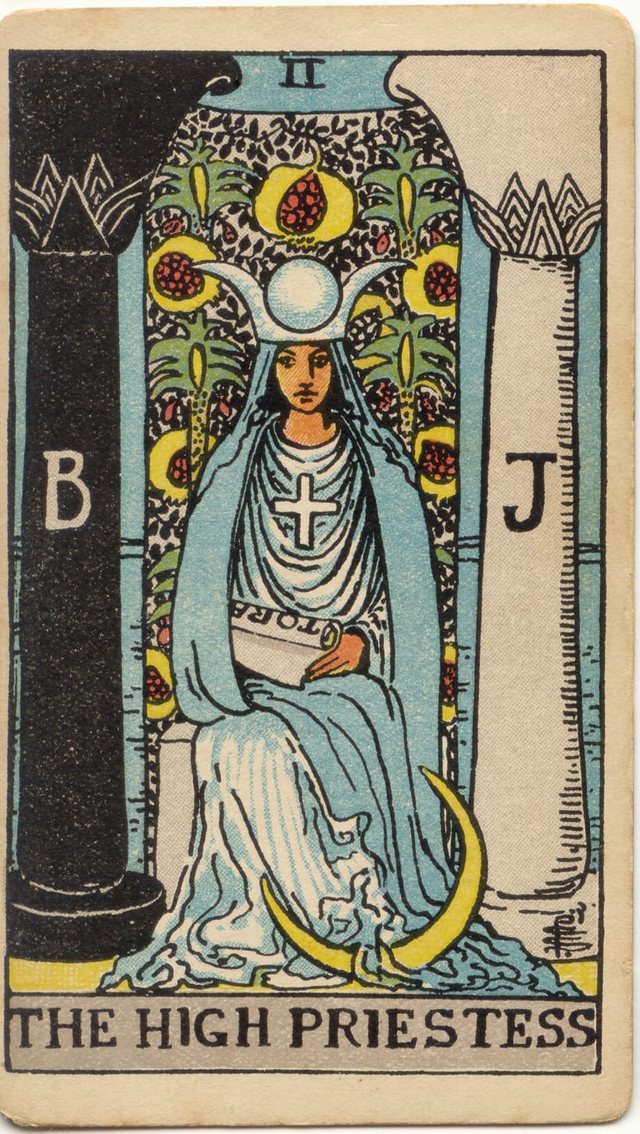
A woman in pale blue sits very still between two pillars, a black one marked B and a white one marked J. Behind her hangs a veil patterned with palm leaves and pomegranates. She wears a horned crown with a full moon at its centre and a white cross on her breast, and a yellow crescent moon lies at her feet. In her lap is a scroll lettered TORA, half hidden by her robe.
Everything about her is quiet. She makes no gesture and gives no instruction; she simply sits at the threshold of something the viewer cannot see. The card speaks of knowledge that does not come from argument or research: intuition, dreams, the slow understanding that arrives when you stop pushing. In a reading it often suggests that the answer is already in you but not yet ready to be put into words, and that patience will show you more than effort.
She is also a card of secrets in the plain sense. Something may be unspoken in the situation, and the scroll she half conceals hints that some truths are only partly available. The High Priestess does not ask you to drag them out. She asks you to notice what you sense, to keep a confidence where one is owed, and to accept that some things become clear only in their own time.
The High Priestess reversed
Reversed, the High Priestess often points to intuition overruled: you sensed something and talked yourself out of it, or you are gathering so many opinions that you cannot hear your own. It can also mean being cut off from your inner life, filling every silence with noise.
Some readers take the reversal as secrets coming to the surface, or as a warning about hidden agendas. Waite's list gives surface knowledge as one reversed meaning, and that fits as well: knowing about something without really understanding it. In each case the card asks you to slow down, step away from the chatter, and listen for what is quieter.
In love and relationships
In love the High Priestess is attraction that runs deeper than words: a pull you cannot quite explain, or a relationship in which a great deal is understood without being said. It can also point to something withheld, feelings one person has not disclosed, or a part of a partner that stays private. That is not always a problem; she respects privacy. For someone single, it suggests waiting and paying attention rather than chasing. Reversed, it can mean ignoring an instinct about someone, or secrets that are straining trust.
In work and purpose
At work the card favours research, study and quiet observation over loud action. It can show that not all the facts are on the table yet, so it is wise to listen before committing. It suits counsellors, researchers, archivists and anyone whose work depends on discretion. If you are weighing a decision, it asks what your instinct already tells you. Reversed, it can warn of information being withheld, politics conducted out of sight, or a habit of dismissing your own judgement.
As advice
Be quiet for a while and pay attention to what you already sense. Not every question needs an immediate answer, and not every thought needs to be shared. Keep your own counsel, trust the impression that keeps returning, and let the situation show you more before you act.
Yes or no?
Maybe The High Priestess holds something back: the answer is not yet revealed, so she reads as not yet, or look more closely. How yes-or-no readings work here.
Questions to sit with
- What do I already know about this that I have not admitted to myself?
- Where am I filling silence with noise because the quiet makes me uneasy?
- What is being left unsaid around me, and do I need to ask, or to wait?
Symbolism in the card
The black and white pillars
Two pillars flank her, a black one lettered B on the left and a white one lettered J on the right. They are Boaz and Jachin from the porch of Solomon's temple. Their contrast makes the card a threshold between opposites: dark and light, hidden and revealed.
The veil of palms and pomegranates
A veil stretched between the pillars is patterned with green palm leaves and red-seeded pomegranates. It screens whatever lies beyond. The pomegranate, crowded with seeds and tied to the myth of Persephone, carries ideas of fertility and of the underworld.
The horned crown
Her crown is a white full moon held between two curved horns. It recalls the headdress of the Egyptian goddess Isis, and many readers see in it the moon waxing, full and waning: the whole cycle at once.
The Tora scroll
The scroll in her lap shows the letters TORA, partly covered by her robe. Torah is the Hebrew word for the Law. Waite says the covering shows 'that some things are implied and some spoken': she holds more than she reveals.
Hebrew letters and inscriptions in tarotScrolls and books in tarot
The crescent moon
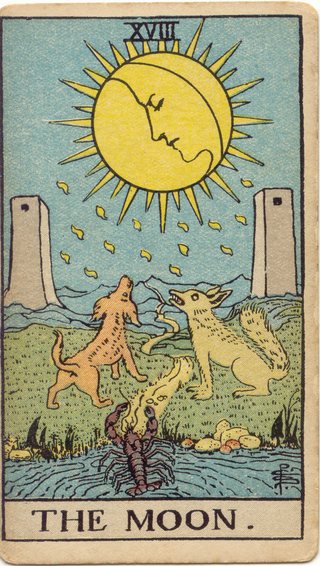
A yellow crescent moon lies at her feet, half tangled in the folds of her robe. The moon gives reflected rather than direct light, and it governs dreams, cycles and intuition. It looks ahead to the Moon card, card XVIII.
The solar cross
A plain white cross with equal arms sits on her breast. Waite calls it a solar cross. Its four equal arms suggest balance between the elements and a meeting point of spirit and matter.
The flowing blue robe
Her pale blue mantle pours down and spreads across the floor in rippling folds, almost like water. Many readers see it as the source of the streams that run through later cards. Blue is the colour of depth, coolness and reflection.
“The scroll in her hands is inscribed with the word Tora, signifying the Greater Law, the Secret Law and the second sense of the Word. It is partly covered by her mantle, to shew that some things are implied and some spoken.”
Numbers, elements and astrology
Number 2: Two
Two brings a second thing, and with it relationship, choice and balance. Twos are about pairs, partnerships and decisions between options.
These are the traditional attributions of the Hermetic Order of the Golden Dawn (1888), which Waite and Smith followed: each trump is matched to a Hebrew letter and to an element, planet or zodiac sign. They are a symbolic system, not astronomy. How we checked them.
A little history
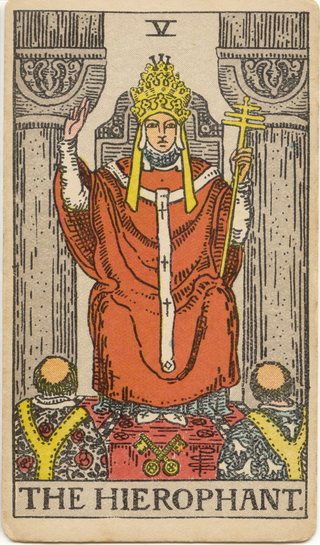
In early Italian decks and the Tarot de Marseille this card is the Popess, La Papesse: a woman in a papal tiara holding a book. The image puzzled later commentators, and explanations range from the legend of Pope Joan to an allegory of the Church; none is certain. In the eighteenth century Antoine Court de Gébelin reinterpreted the Pope and Popess as a high priest and high priestess, and the occult tradition followed him. Smith's design drops the tiara and book, seats her between the pillars B and J, and gives her the lunar crown and the Tora scroll.