King of Cups
Upright emotional balance · calm authority · compassion with control · diplomacy · wise counsel
Reversed suppressed feelings · manipulation · moodiness · coldness · losing composure
- Arcana
- Minor · court card
- Number
- King
- Element
- 🜄 Water
- Sub-element
- Fire or Air of Water (varies)
- Yes or no
- Yes
King of Cups upright
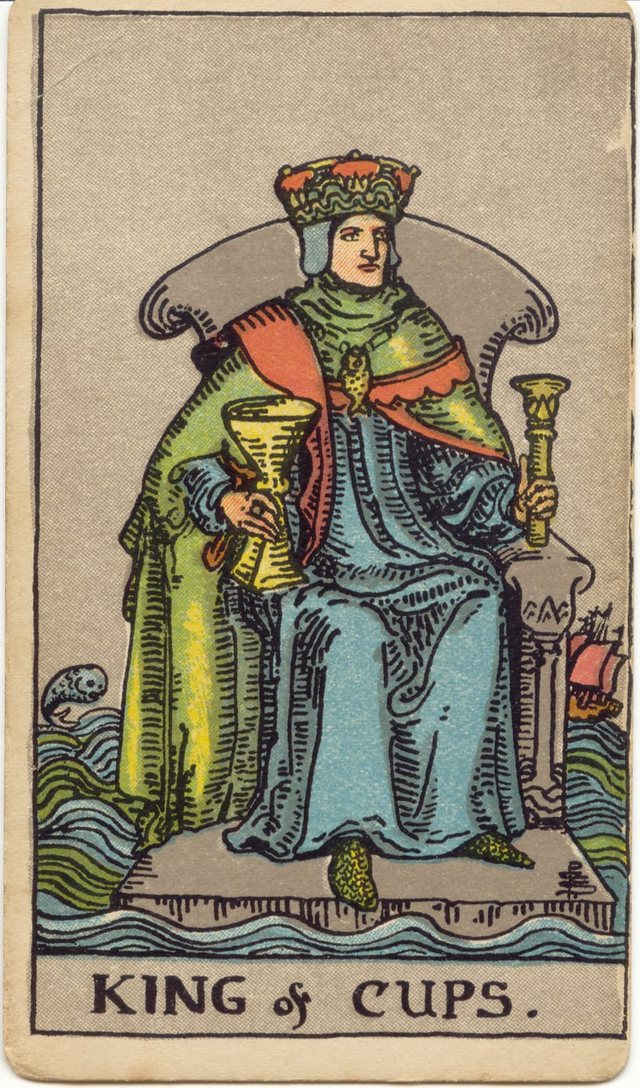
A king sits on a broad stone throne that floats on a rough green and blue sea. In his right hand he holds a large gold cup, in his left a short sceptre. He wears a crown over a pale cap, a long blue robe, a green cloak with a red collar, and a small ornament on a chain at his chest. To the left a fish leaps from the waves; to the right a ship with red sails rides the sea. The background is a plain grey.
As a person, the King of Cups is emotionally mature: someone who feels as much as the Queen but has learned to hold steady while doing so. He may be a mentor, a doctor, a counsellor, a calm parent, or the part of you that can stay kind when things are hard. Waite lists among his meanings people of 'law, or divinity', and 'creative intelligence'.
As an approach, the King suggests mastery of feeling rather than suppression of it. His throne does not sink and he does not try to calm the sea; he simply sits with dignity in the middle of it. The card asks you to respond rather than react, to keep compassion and judgement together, and to be a steady presence for people who need one.
King of Cups reversed
Reversed, the King's control can tip in either direction. Many readers see feelings buried so deep that they come out sideways: coldness, irritability, or a calm surface laid over real turbulence. It can also describe someone who uses emotional understanding to manipulate rather than to help.
Waite's reversed meanings are severe: 'Dishonest, double-dealing man', 'injustice', 'considerable loss'. Most modern readers take the reversal more gently, as a time when your own composure is slipping and you need to admit what you feel. As with every court card, it may describe a person in your life or a side of yourself.
In love and relationships
In love the King of Cups describes a partner who is emotionally steady, kind and dependable: someone who can talk about feelings without drama and stays present in difficult moments. It can also be you becoming that kind of partner. For someone single, it may describe meeting a mature, caring person. Reversed, it may point to emotional unavailability, someone who keeps their feelings locked away, or a partner who uses charm to control.
In work and purpose
At work the King suits leadership that depends on empathy: managers people trust, advisers, teachers, carers, and anyone who must stay calm when others are anxious. It describes the ability to handle conflict without escalating it. It can also point to work that combines care with professional skill. Reversed, it may warn of a manager whose moods dominate the office, or of your own frustration being kept under a lid that will not hold.
As advice
Stay steady. Feel what you feel, fully, and then choose how to act. You do not need to calm every wave around you, only to keep your seat. Offer others patience and understanding, and let them see that strong feeling and good judgement can live in the same person.
Yes or no?
Yes The King's calm and goodwill make the card a measured yes, especially where patience and diplomacy are needed. How yes-or-no readings work here.
Questions to sit with
- How do I stay steady when the people around me are not?
- Which feelings am I managing well, and which am I simply burying?
- Where could I offer calm, wise support to someone who needs it?
Symbolism in the card
The throne on the sea
His stone throne rests on a square block surrounded by waves. Waite notes that 'his throne is set upon the sea'. It is emotional stability: sitting calmly in the middle of turbulent feelings without being swept away.
Thrones in tarotWater, rivers and pools in tarotCube and stone in tarot
The cup and sceptre
He holds a large gold cup in his right hand and a short gold sceptre in his left. Cup and sceptre together join feeling with authority: he rules, but through understanding.
The leaping fish
On the left a grey fish, which Waite calls a dolphin, leaps from the waves. It suggests the creative and emotional life beneath the surface, lively and free, which the King keeps in view.
The ship
On the right a ship with red sails rides the sea. Waite pairs it with the fish. It suggests the practical world of trade and travel, the King's ability to steer through feelings and still get somewhere.
The pendant
A small ornament hangs at his chest, usually described as a fish, though in the scan its shape is hard to make out. If it is a fish, it marks the water of his suit as something he wears close to the heart, part of his identity rather than only his surroundings.
The robes and cloak
He wears a long blue robe under a green cloak with a red scalloped collar. Blue suggests calm and depth, green growth, and the touch of red the warmth beneath his composure.
The crown
His crown sits over a pale close-fitting cap. It confirms his authority, though his expression is watchful rather than commanding, the face of someone who listens before he speaks.
“He holds a short sceptre in his left hand and a great cup in his right; his throne is set upon the sea; on one side a ship is riding and on the other a dolphin is leaping.”
Numbers, elements and astrology
King
Kings direct the suit outwardly: authority, responsibility and the mature use of its power.
Water: the suit of Cups
Water is feeling, intuition, relationships and the imagination.
In the Golden Dawn system each court card is an element within its suit's element. Pages and Queens are agreed; Knights and Kings are Fire or Air depending on whether you follow the Golden Dawn's names or later practice. They are a symbolic system, not astronomy. How we checked them.
A little history
The King descends from the Roy de Coupe of the Tarot de Marseille, a seated king with a cup. The Golden Dawn reorganised and renamed its court figures, but Waite kept the older title of King. His divinatory notes give the card a strongly professional character, with 'man of business, law, or divinity' and those 'who profess science, law and art'. The throne floating on the sea, with ship and dolphin, is part of the 1909 design and is described in Waite's own text.