Major Arcana · X
Wheel of Fortune
Upright cycles · change · turning point · chance · momentum
Reversed resisting change · a run of setbacks · stagnation · repeating patterns
- Arcana
- Major
- Number
- X
- Astrology
- ♃ Jupiter
- Hebrew letter
- Kaph כ
- Yes or no
- Yes
Wheel of Fortune upright
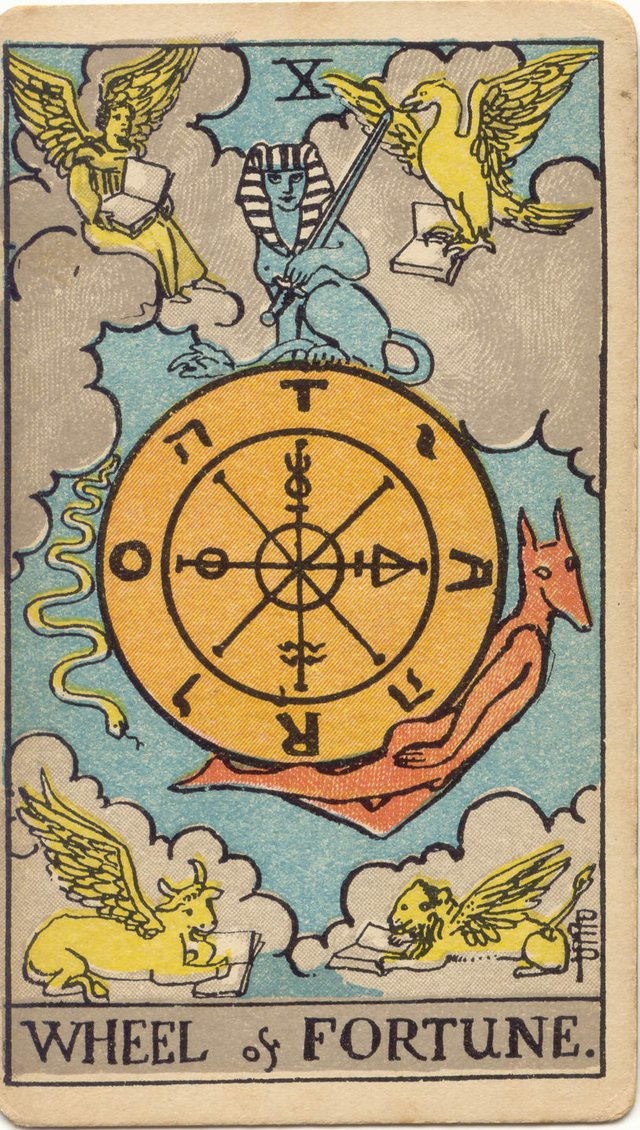
A great orange wheel hangs in a blue sky full of grey clouds. Its outer ring carries the letters T, A, R and O alternating with four Hebrew letters, and its spokes carry alchemical signs. A blue sphinx holding a sword sits on top, a yellow snake slides down the left side, and a red jackal-headed figure rises on the right. In the four corners, winged creatures read open books: an angel, an eagle, a bull and a lion.
This is the card of the turning world. Things rise and fall: seasons, fortunes, moods, relationships. The Wheel is a reminder that no position on it is permanent, which is a comfort when you are near the bottom and a sobering thought near the top. In a reading it often marks a turning point, a change of circumstances that seems to arrive from outside, or the sense that events are moving faster than you can steer.
But the card is not about helplessness. The sphinx sits calmly at the top, and the four creatures go on reading in their corners. Within all the movement something stays steady: your values, your attention, the way you choose to respond. The Wheel invites you to notice which patterns keep coming round and to work with the turn rather than against it. Waite himself saw in the design a denial of blind chance.
Wheel of Fortune reversed
When the Wheel appears reversed, it can describe a stretch in which things seem to go wrong one after another, or a change you are resisting so hard that it becomes more painful than it needs to be. It can also show stagnation: the wheel stuck, nothing moving at all.
Many readers take the reversal as a prompt to look at repeating cycles, the same argument, the same kind of job, the same disappointment, and to ask what part you play in them. The wheel keeps turning either way. What you learn from the downturn shapes how you meet the next rise.
In love and relationships
In love the Wheel points to change and timing: an unexpected meeting, a relationship moving into a new phase, or a familiar pattern repeating itself. It can carry the feeling that something was meant to be, or simply that circumstances have shifted. If you are going through a hard stretch, the card is a reminder that no phase lasts for ever. Reversed, it may show a cycle you keep repeating with partners, or timing that keeps getting in the way.
In work and purpose
At work the Wheel describes shifting conditions: a reorganisation, a change in your field, an unexpected opening or the end of a lucky run. It favours adaptability and a readiness to take an opportunity when it appears. It can also point to cycles in a career, such as returning to work you once left behind. Reversed, it may describe setbacks you cannot control, or the strain of resisting a change that is already under way.
As advice
Accept that some things are beyond your control and put your energy into how you respond. Watch for the patterns that keep returning, take openings when they come, and hold your values steady while circumstances change around you. You cannot stop the wheel, but you can choose where you stand on it.
Yes or no?
Yes The Wheel turns towards change and opportunity, so it reads as yes, though the timing may not be in your hands. How yes-or-no readings work here.
Questions to sit with
- What cycle in my life keeps coming back, and what is it asking me to learn?
- Which parts of this situation can I influence, and which must I accept?
- How do I behave when things go well, and how when they go badly?
Symbolism in the card
The wheel
The large orange wheel has two rings and eight spokes radiating from a small hub. It stands for cycles, fate and time, everything that turns. Its centre barely moves, which many readers take as the still point within change.
The letters on the rim
The outer ring carries T, A, R, O, which can be read as TARO, ROTA (Latin for wheel) or TORA, alternating with the four Hebrew letters of the divine name. Waite says they are there 'to shew that Providence is implied through all'.
The alchemical signs
Four signs sit on the spokes of the inner wheel, usually identified as the alchemical symbols for mercury, sulphur, salt and water. They stand for the basic stuff of transformation: a world that is constantly being remade.
The sphinx
A blue sphinx in a striped headdress sits on top of the wheel holding an upright sword. Waite calls it 'the equilibrium therein': judgement and wisdom staying steady while everything beneath it turns.
The snake
A yellow snake winds down the left side of the wheel. Waite names it Typhon, a destructive figure Greek writers identified with the Egyptian god Set, here in serpent form: the fall that comes with every turn.
The jackal-headed figure
A red figure with a jackal's head rides up the right side of the wheel on its back. It resembles Anubis, the Egyptian guide of souls, and is often called Hermanubis in the occult tradition: the rise that balances the serpent's descent.
The four living creatures
An angel, an eagle, a bull and a lion sit on clouds in the corners, each with an open book. They are the creatures of Ezekiel's vision and Revelation, later the emblems of the four Evangelists, and are often linked to the fixed signs of the zodiac. They return on the World.
The four living creatures in tarotAngels and wings in tarotEagle in tarotBull in tarotLion in tarotScrolls and books in tarot
The clouds and sky
The wheel floats among heavy grey clouds in a blue sky, with no ground anywhere beneath it. It belongs to the heavens: whatever turns it lies beyond ordinary reach.
“With the French occultist, and in the design itself, the symbolic picture stands for the perpetual motion of a fluidic universe and for the flux of human life. The Sphinx is the equilibrium therein.”
Numbers, elements and astrology
Number 10: Ten
Ten completes one cycle and begins the next (1 + 0 = 1). Tens show a suit carried to its end, for better or worse.
These are the traditional attributions of the Hermetic Order of the Golden Dawn (1888), which Waite and Smith followed: each trump is matched to a Hebrew letter and to an element, planet or zodiac sign. They are a symbolic system, not astronomy. How we checked them.
A little history
Fortune's wheel was a familiar medieval image long before tarot: a goddess turning a wheel on which rulers rise and fall. The fifteenth-century Visconti-Sforza card shows Fortune at the centre with figures labelled in Latin, regnabo, regno, regnavi, sum sine regno: I shall reign, I reign, I have reigned, I am without a kingdom. The Tarot de Marseille's La Roue de Fortune turns the riders into strange animal figures, one crowned at the top. Éliphas Lévi reworked the wheel with a sphinx and Egyptian figures, and Waite followed him, setting the four living creatures of Ezekiel in the corners and insisting that the Egyptian imagery implied no theory of tarot's origins.