Queen of Cups
Upright compassion · intuition · emotional wisdom · a caring presence · calm depth
Reversed emotional overwhelm · poor boundaries · moodiness · self-neglect · dependence
- Arcana
- Minor · court card
- Number
- Queen
- Element
- 🜄 Water
- Sub-element
- Water of Water
- Yes or no
- Yes
Queen of Cups upright
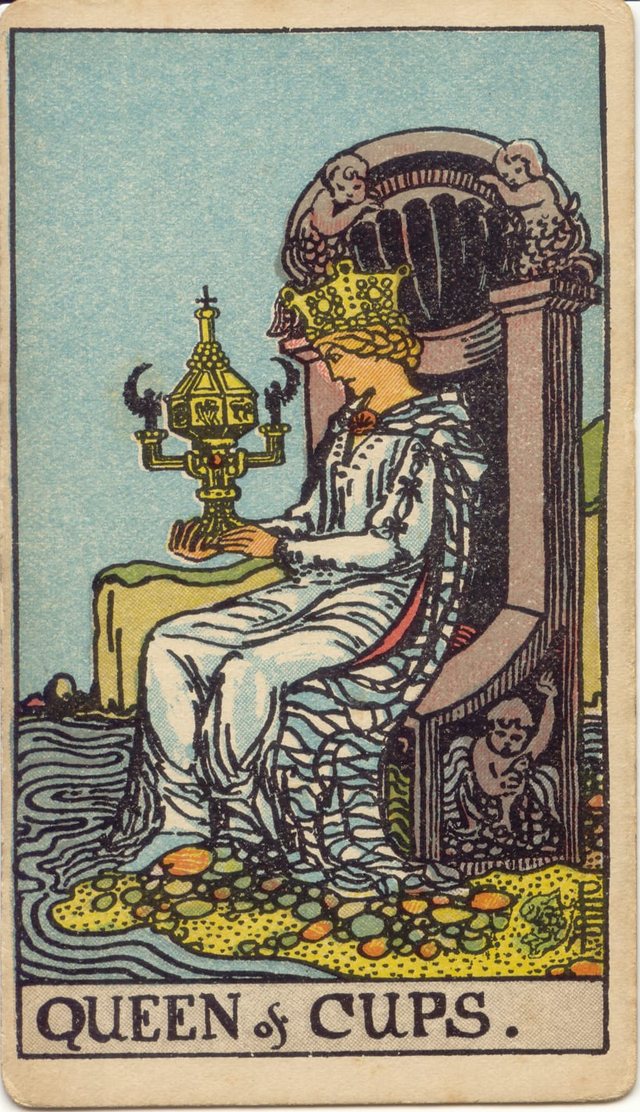
A queen sits on a carved stone throne at the very edge of the sea, her feet on a strip of coloured pebbles with the water lapping right up to them. She gazes intently at the cup she holds in both hands, an elaborate gold vessel with a lid topped by a small cross and two winged figures for handles. It is the only closed cup in the suit. Small child-like sea figures are carved on the top and the side of her throne, and her white gown and mantle fall around her in rippling lines like water.
As a person, the Queen of Cups is someone of great emotional depth: perceptive, compassionate, a good listener, often intuitive to the point of seeming to know what others feel before they say it. She may be a friend, a counsellor, a parent, a partner, or your own capacity for empathy. Waite calls her one 'who sees visions in a cup', and then adds what matters most: 'she sees, but she also acts'.
As an approach to a situation, she suggests leading with understanding: listening before deciding, trusting what you sense, and offering care that is steady rather than sentimental. Her closed cup hints that she does not spill everything she feels. She holds her inner life with reverence, and that self-possession is what makes her kindness reliable.
Queen of Cups reversed
Reversed, the Queen's sensitivity can lose its shore. Many readers see someone overwhelmed by feelings, their own or other people's: taking on others' moods, struggling to say no, or giving care to everyone except themselves. It can also describe moodiness, emotional manipulation or a reliance on others for reassurance.
Waite notes that 'The accounts vary' for the reversal, from 'good woman' to 'one not to be trusted'. Many modern readers turn it inward, as a sign to look after your own emotional wellbeing and rebuild boundaries. Read as another person, it may describe someone whose warmth comes with strings or who drowns those around them in their feelings.
In love and relationships
In love the Queen of Cups describes deep emotional attunement: a partner who truly listens, or a time when you are open, caring and generous. It favours relationships built on empathy and emotional honesty. For someone single, it can suggest becoming the kind of person who can love well, or meeting someone gentle and perceptive. Reversed, it may point to codependency, giving too much, or a partner whose moods dominate the relationship.
In work and purpose
At work the Queen suits counselling, care, teaching, healing professions and the arts, and any role that depends on reading people well. She can describe a manager or colleague who creates trust and emotional safety. She also asks you to bring intuition into decisions alongside analysis. Reversed, she may warn of burnout from emotional labour, taking colleagues' problems home, or a working relationship so tangled with feelings that clear decisions become hard.
As advice
Trust what you sense, and let compassion guide what you do. Listen fully before you respond. At the same time, keep your own cup covered when you need to: you can care deeply without taking on everyone's tides. Your kindness is strongest when you are standing on your own shore.
Yes or no?
Yes The Queen is a warm, nurturing presence, so the card reads as yes, particularly where kindness and understanding are involved. How yes-or-no readings work here.
Questions to sit with
- What is my intuition telling me that I have not yet listened to?
- Where am I giving care to others at the expense of caring for myself?
- How can I act on what I feel, rather than only feeling it?
Symbolism in the card
The covered cup
She holds an ornate gold vessel with a lid, crowned by a small cross and flanked by two winged figures for handles. It is the only lidded cup in the suit: feeling held as something sacred, and kept rather than poured out.
Angels and wings in tarotCrosses in tarotCups and chalices in tarot
Her intent gaze
She stares steadily at the cup, absorbed in it. This is the picture of intuition and reflection that Waite describes: one 'who sees visions in a cup', looking deep into her inner life.
The throne at the water's edge
Her heavy carved throne stands right at the shoreline, with the sea flowing up to her feet. She lives where solid ground meets emotional depth, belonging to both.
The sea figures on the throne
The throne is carved with small child-like figures: two at the top and one in a niche at the side. They are often read as water spirits or undines, though Waite does not explain them, and their exact forms are hard to make out.
The pebbles
Her feet rest on a strip of coloured pebbles in orange, green and grey. They are small, solid things at the water's edge: a reminder of the ordinary ground the Queen stands on.
The rippling robes
Her white gown and long mantle are drawn with flowing, wavy lines that look almost like water. Her clothing seems to merge with the sea, showing a person through whom feeling flows.
The crown
She wears a gold crown studded with round shapes, over braided fair hair. It gives her authority, but her bowed head and inward gaze suggest that her rule is quiet and personal.
“Beautiful, fair, dreamy—as one who sees visions in a cup. This is, however, only one of her aspects; she sees, but she also acts, and her activity feeds her dream.”
Numbers, elements and astrology
Queen
Queens hold the suit inwardly: mastery that is receptive, nurturing and self-possessed.
Water: the suit of Cups
Water is feeling, intuition, relationships and the imagination.
In the Golden Dawn system each court card is an element within its suit's element. Pages and Queens are agreed; Knights and Kings are Fire or Air depending on whether you follow the Golden Dawn's names or later practice. They are a symbolic system, not astronomy. How we checked them.
A little history
The Queen descends from the Reyne de Coupe of the Tarot de Marseille, an enthroned woman holding a cup. In the Golden Dawn system the Queens stand for the watery part of their element, which makes this card the water of water. Waite's own divinatory notes for her are notably mixed, praising her as 'a perfect spouse and a good mother' and giving the reversal as a woman 'not to be trusted'. The covered cup, the shore and the carved sea figures are features of Smith's 1909 design.