
The Fool’s journey
One popular way to read the Major Arcana is as a single story: the Fool, the unnumbered card, sets out at the beginning and meets each of the other trumps in turn, learning from every one, until the circle closes in the World. This is not an ancient key to the cards. It is a twentieth-century reading, made popular by American tarot writers of the 1960s and 1970s and often traced to the books of Eden Gray, and it builds on the Golden Dawn's habit of treating the trumps as stages on a path of initiation.
Read it as one lens among several. The same cards can be read as a set of separate archetypes, as three rows of seven, or as a map of the Kabbalistic Tree of Life, and none of these is the true meaning. What the journey offers is a way of remembering the majors in order and of seeing how each card might grow out of the last, as the stages of an ordinary human life: beginning, learning, choosing, losing, starting again and, if all goes well, arriving somewhere whole.
-
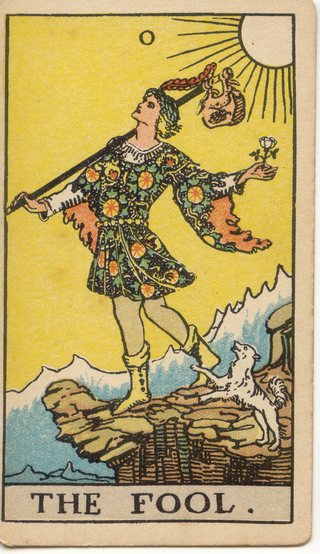
0 · The Fool
Setting out
Every story needs someone willing to start it. The Fool steps towards a cliff edge with a white rose in one hand and a light bundle over his shoulder, eyes on the sky rather than the drop. He is not yet anyone in particular, and that is his freedom. In the journey he stands for the part of us that begins things without knowing how they end: the newborn, the beginner, the person who says yes before the doubts arrive.
-
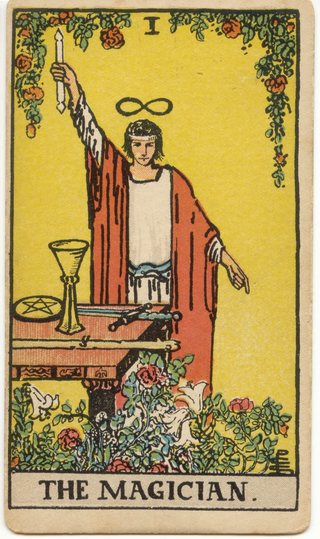
I · The Magician
Discovering what you can do
The first thing the traveller meets is his own capacity. The Magician stands at a table with a cup, a coin, a sword and a wand laid out before him, one hand raised and one pointing down. All the tools of the four suits are there, and the lesson is simply that they can be used. This is the stage of first skill and first intention, the child who realises that wanting something and acting on it can make it happen.
-
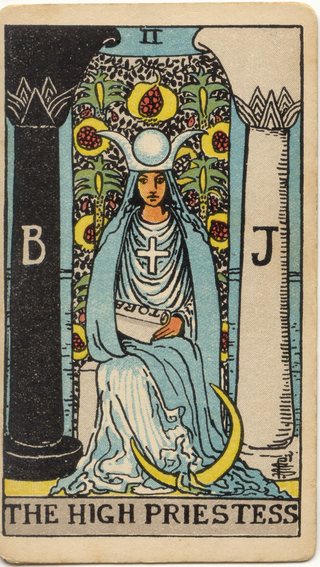
II · The High Priestess
Meeting what cannot be said
Next comes the opposite lesson. The High Priestess sits still between a dark pillar and a light one, a scroll half hidden in her lap and a veil of pomegranates behind her. Not everything can be done; some things have to be known, or waited for. Here the traveller first senses an inner life, intuition and mystery, the knowledge that does not come from tools or instruction but from attention and silence.
-
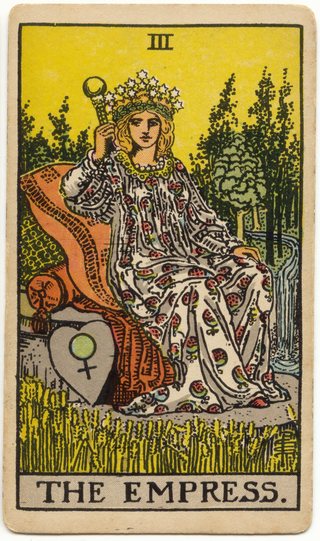
III · The Empress
Being nourished
The Empress is abundance: a woman at ease among ripening wheat, trees and running water, her shield marked with the sign of Venus. In the journey she is the experience of being cared for and of the senses waking up, the world as something generous, beautiful and alive. She also teaches that growth takes time and comfort, and that the body and the natural world are part of any wisdom worth having.
-
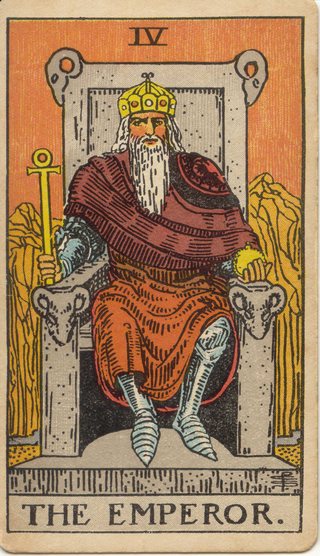
IV · The Emperor
Learning the rules
From the mother the traveller passes to the father, or at least to the principle of order. The Emperor sits on a stone throne carved with rams' heads, armour under his robe and bare mountains behind him. Here the world acquires structure: boundaries, laws, responsibility and the use of authority. It can feel stern after the Empress's garden, but without some structure nothing she grows can be protected.
-
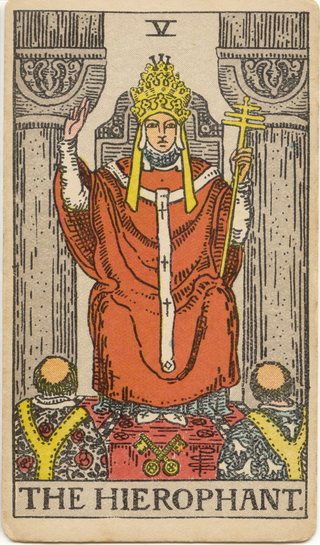
V · The Hierophant
Joining a tradition
The Hierophant raises his hand in blessing over two kneeling followers, crossed keys at his feet. After the personal authority of the Emperor comes the authority of a shared tradition: religion, education, inherited wisdom, the customs of a community. The traveller learns that he belongs to something older than himself and receives its teachings. Whether he keeps them, questions them or later leaves them is a matter for the cards to come.
-
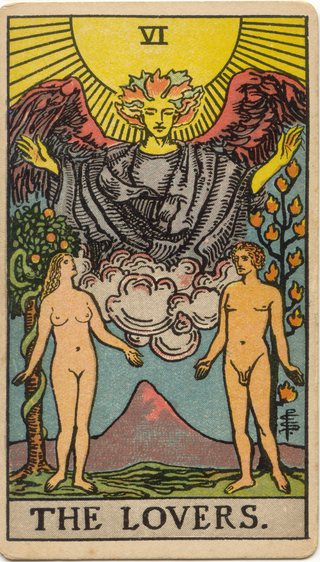
VI · The Lovers
Choosing
Under an angel and a blazing sun, a man and a woman stand naked in a garden, a serpent coiled round the tree behind her. The Lovers mark the first great choice that is truly one's own: in love, but also in values. Until now the traveller has been taught; here he must decide what he cares about and whom he will stand beside, and accept that every real choice closes some doors as it opens others.
-
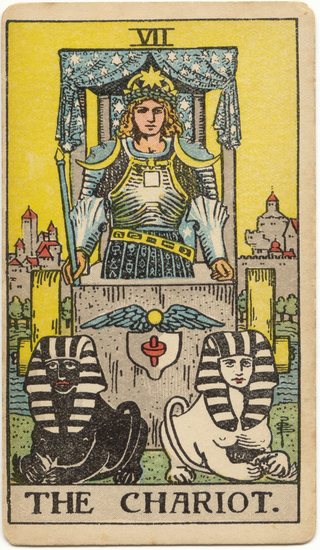
VII · The Chariot
Going out into the world
Having chosen, the traveller sets off with purpose. The Chariot's driver stands armoured under a canopy of stars, the walled town behind him, with a black sphinx and a white one at rest before the car. He holds no reins. This is the stage of drive and self-command, the young adult who succeeds by force of will, holding opposing impulses together long enough to make progress.
-
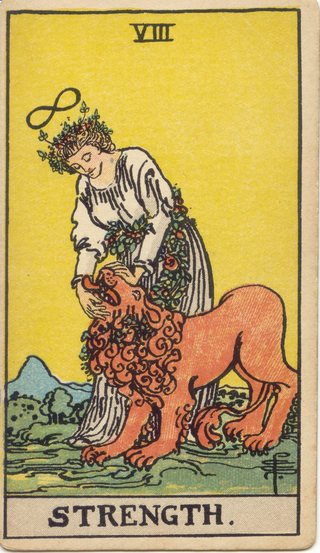
VIII · Strength
Gentleness that holds
The first half of the journey ends with a quieter kind of victory. A woman in white closes a lion's jaws with her bare hands, a garland of flowers looping from her waist to the animal, the infinity sign above her head. Where the Chariot mastered by will, Strength masters by patience and kindness. The traveller learns to live with his own wildness instead of fighting it, and finds that courage can be calm.
-
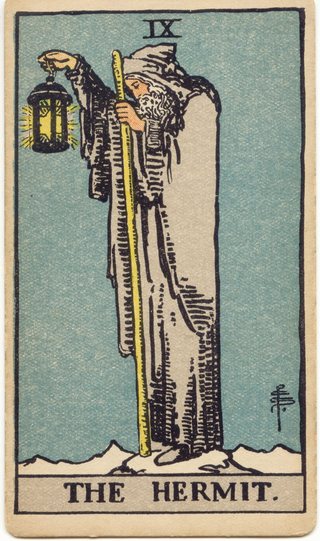
IX · The Hermit
Turning inward
Success in the world raises a question it cannot answer, and the traveller withdraws to find out what he actually thinks. The Hermit stands alone on a snowy height in a grey hooded cloak, holding up a lantern with a star inside. He has left the crowd behind, not out of bitterness but to see clearly. This is the stage of solitude, reflection and seeking a teacher or becoming one.
-
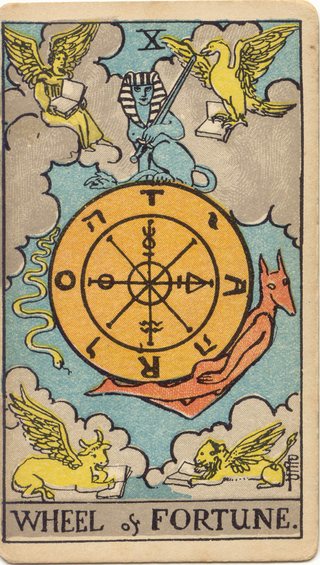
X · Wheel of Fortune
Meeting chance
Coming back from solitude, the traveller finds that the world has been turning without him. The great Wheel spins in the clouds with a sphinx on top, a serpent going down one side and a jackal-headed figure rising on the other, while four winged creatures read in the corners. Fortune is the lesson that much in life is beyond control: cycles, luck, timing. The question is how to stand in the midst of change.
-
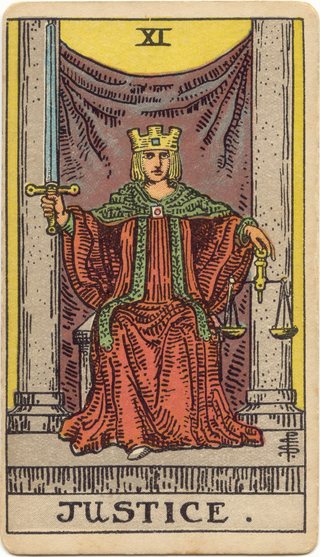
XI · Justice
Taking responsibility
If the Wheel shows what happens to us, Justice asks what we did. She sits between two pillars with an upright sword and a pair of scales, looking straight out of the card. At the midpoint of the sequence the traveller takes an honest account of his life: actions and consequences, fairness to others and to himself. It is a sober card, and a necessary one before the deeper changes that follow.
-
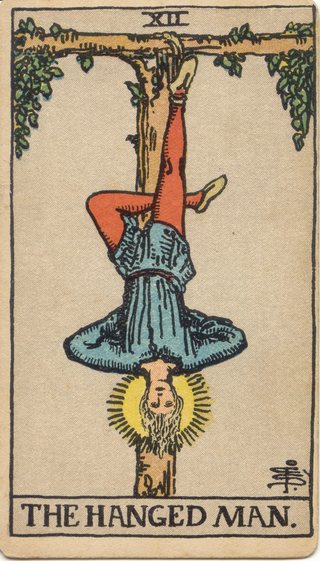
XII · The Hanged Man
Letting go of control
The Hanged Man hangs by one foot from a living tree, calm, with a halo of light round his head. Everything the traveller has gained through will and judgement is suspended here. He cannot act, and instead he learns to see the world the other way up. It is the stage of surrender, sacrifice or simply waiting, when a change of perspective matters more than any move.
-
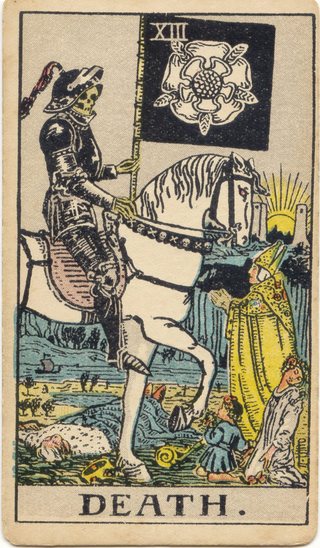
XIII · Death
An ending
An armoured skeleton rides a white horse under a black banner bearing a white rose; a king has fallen before him and a bishop, a girl and a child kneel or turn away, while the sun rises between two towers. In the journey Death is not a literal death but the end of a whole way of being. Something the traveller has been must go, so that what comes next has room.
-
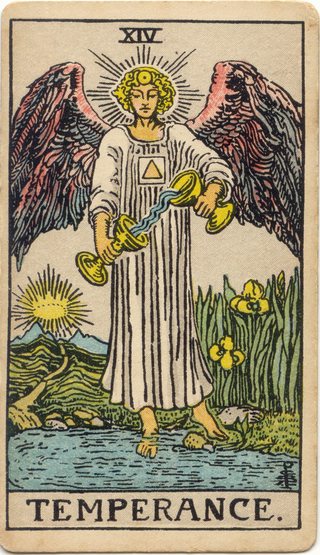
XIV · Temperance
Healing and blending
After the ending comes slow repair. A winged angel stands with one foot on land and one in a pool, pouring water between two cups, with a path leading towards a crown of light in the distance. Temperance is the patient work of recombining the pieces: moderation, balance, the mixing of opposites into something new. The traveller learns that wholeness is made gradually, by small and careful adjustments.
-
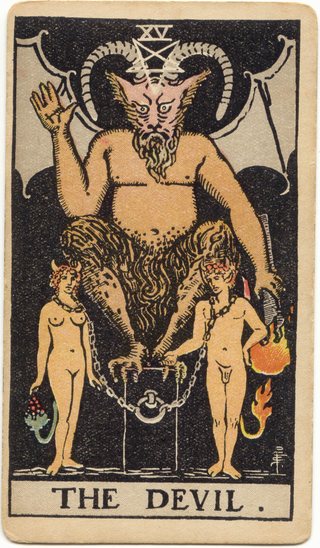
XV · The Devil
Facing what binds
With a measure of balance comes the strength to look at what still holds the traveller back. The Devil squats on a black block above a chained man and woman who have begun to grow horns and tails. Their chains hang loosely; they could lift them off. This is the encounter with habits, cravings and fears that bind us by consent, the shadow that has to be seen before it can be set down.
-
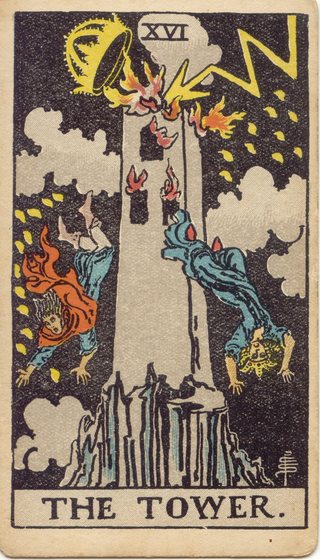
XVI · The Tower
The false structure falls
Lightning strikes a tall tower, knocking off its crown, and two people fall from it into the dark. Whatever the traveller built on false foundations, including false beliefs about himself, comes down at once. It is the most violent card in the sequence and, in the story, a liberation: once the tower is gone, there is nothing left to hide behind, and the sky opens.
-
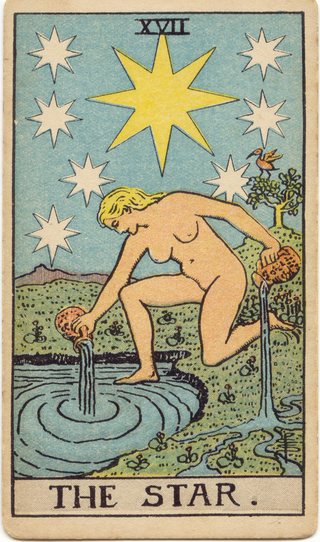
XVII · The Star
Hope returns
Under a great star and seven smaller ones, a naked woman kneels by a pool, pouring water onto the land and back into the water. After the Tower everything is exposed and very quiet. The Star is the first renewal: hope that does not depend on circumstances, a sense of being guided, and the simple act of giving and receiving again. The traveller is unguarded now, and that openness heals.
-
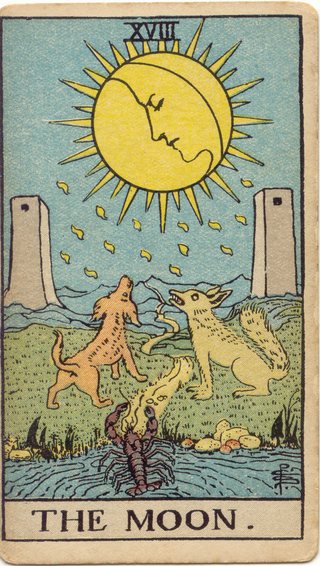
XVIII · The Moon
Through the uncertain night
Hope does not mean the way is clear. Under a moon with a face in profile, a dog and a wolf howl, a crayfish crawls out of a pool, and a path winds between two towers into the distance. The Moon is the passage through confusion, dreams and fear, when nothing can be seen clearly and the traveller must go by instinct. It is often the loneliest stretch of the journey.
-
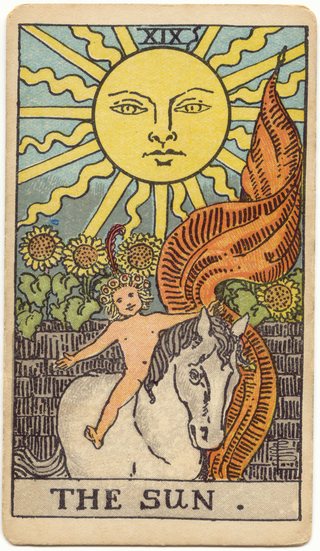
XIX · The Sun
Daylight
Then morning. A naked child rides a white horse beneath a beaming sun, sunflowers over the wall behind him and a red banner streaming from his hand. After the shadows of the Moon everything is visible and simple. The Sun is joy, clarity and vitality, the innocence of the Fool regained but now with experience behind it, which makes it something closer to trust.
-
XX · Judgement
The call
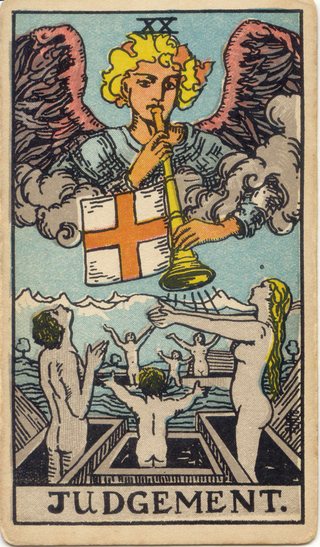
An angel sounds a trumpet hung with a cross-marked banner, and figures rise from coffins floating on the water with their arms raised. In the journey Judgement is awakening: the moment when the traveller hears the call of his own life, takes stock of all he has been, forgives what must be forgiven and rises to answer. It is the last change before completion.
-
XXI · The World
Wholeness
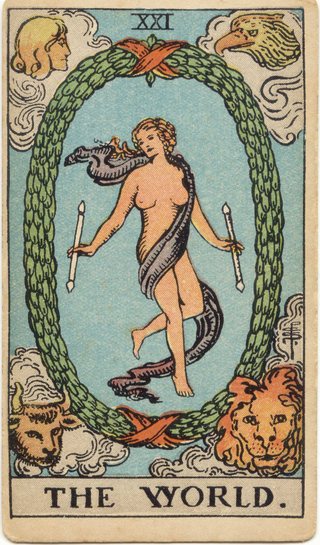
A dancer moves inside an oval wreath, a wand in each hand, with the four creatures of the evangelists in the corners. The World is completion: the parts of the self integrated, the journey understood. It is also a threshold. The dancer is in motion, and the circle of the wreath suggests that the end of one cycle is the beginning of another, when the Fool will step out again.